
One database choice, made in week one, quietly shapes a system for years. SQL and NoSQL are not rivals and neither is “newer and better” — they are two different answers to one question: how is your data shaped, and how will it be asked for?
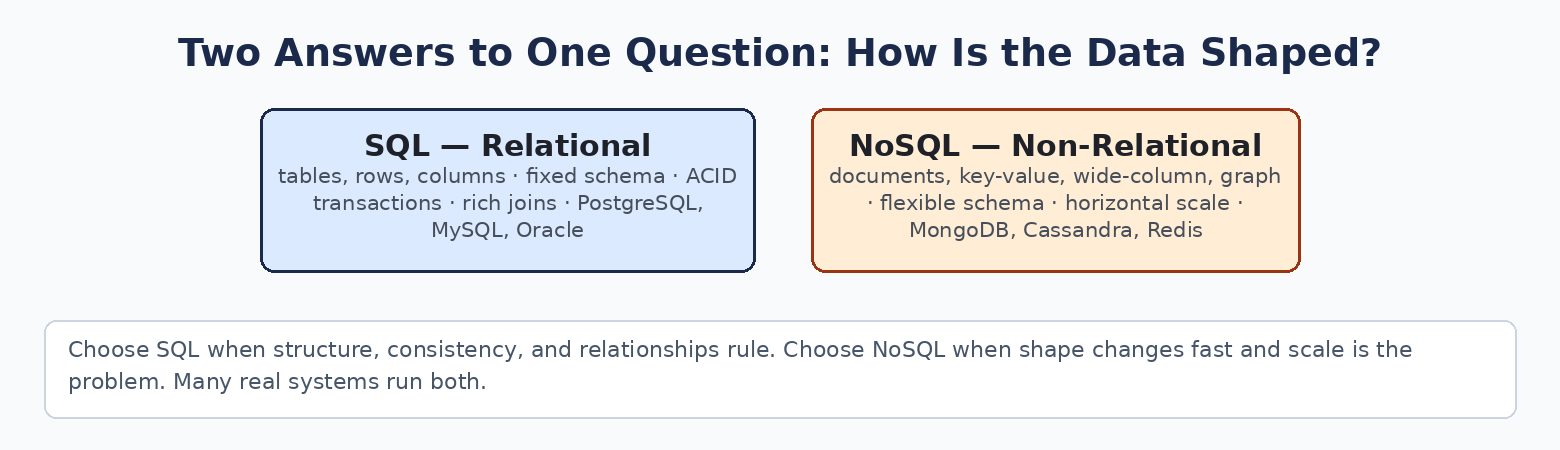
The two shapes
SQL (relational). Data in tables of rows and columns, with a fixed schema defined up front and relationships enforced by the database itself — a Users table, an Orders table pointing at it, a Payments table pointing at orders. Strong consistency and ACID transactions are the native language. Examples: PostgreSQL, MySQL, Oracle.
NoSQL (non-relational). Data in flexible forms — documents (JSON-like records), key-value pairs, wide columns, or graphs. The schema can evolve as the product does, and the systems are designed for horizontal scaling from the start. Examples: MongoDB, Cassandra, Redis.
Side by side
| Feature | SQL | NoSQL |
|---|---|---|
| Data model | Tables and relations | Documents, key-value, wide-column, graph |
| Schema | Fixed, predefined | Dynamic, flexible |
| Scaling | Vertical first, scale-out possible | Horizontal by design |
| Consistency | Strong | Often eventual / tunable |
| Transactions | Strong ACID support | Varies by system |
| Queries | Rich joins and a full query language | Optimized for known access patterns |
| Flexibility | Lower | High |
| Best for | Structured transactional systems | Large-scale, distributed, fast-changing apps |
The same question in both worlds
SQL joins at query time:
SELECT users.name, orders.total
FROM users
JOIN orders ON users.id = orders.user_id;
NoSQL fetches the record shaped for the question:
db.orders.find({ status: "paid"})That contrast is the decision. SQL stores data normalized and assembles answers on demand — any question, answered by joins. NoSQL stores data pre-assembled for the questions you already know — blindingly fast for those, awkward for new ones.
The analogy
SQL is a spreadsheet with strict columns and rules: every row fits the structure, and the structure guarantees the truth. NoSQL is a box of index cards: each card holds whatever that record needs, in whatever shape — perfect for millions of different records, as long as you know how you will look them up.
When to use what
SQL — financial systems, order management, reporting and BI, anything where data integrity, complex relationships, and “the numbers must agree” rule. Banking runs on SQL for a reason.
NoSQL — rapidly evolving products, high-traffic systems, large distributed workloads, semi-structured data: social feeds, content platforms, IoT streams, real-time analytics.
And the grown-up answer: many real systems run both — SQL for the transactional core where correctness is law, NoSQL beside it where scale and flexibility matter more. The choice is per workload, not per company.
The bottom line
Choose SQL when structure, consistency, and relationships matter most. Choose NoSQL when the shape changes fast and scale is the problem actually in front of you. Get the data shape right, and the rest of the architecture gets easier.
Data decisions are the deepest layer of every system — the free toolkits map what sits on top of them.

