
This is the most argued decision in software architecture, and most teams make it for the wrong reason — fashion, a conference talk, or a resume. The honest version is simpler: a monolith is one application that deploys together; microservices are many small applications that deploy independently. Everything else follows from that.
The two shapes
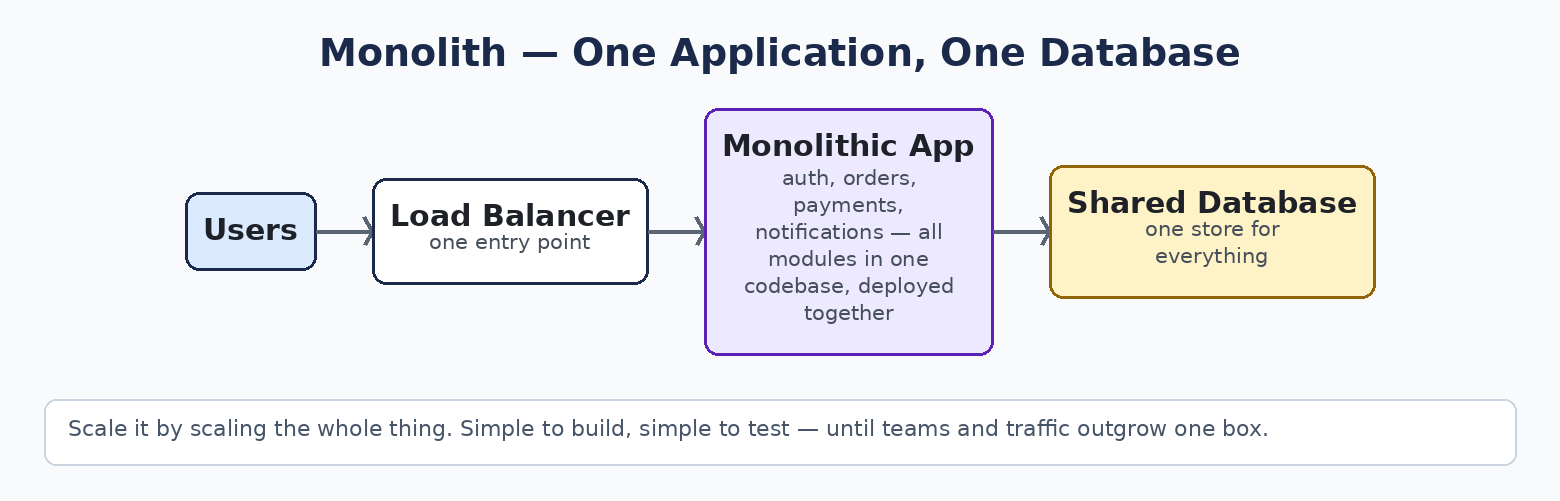
Monolith. All modules — auth, orders, payments, notifications — live in one codebase, deploy as one unit, and usually share one database. A request travels inside a single process: function calls, not network calls.
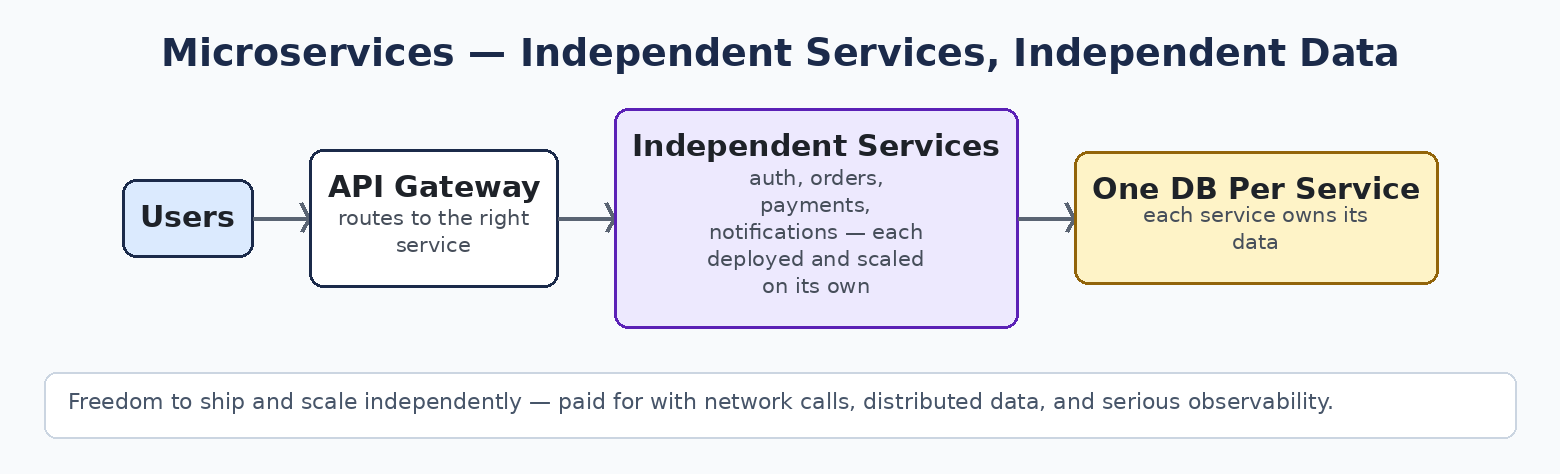
Microservices. The application is split by business capability. Each service owns one job, its own codebase, its own deployment pipeline, and its own database. Services talk through APIs and events.
Side by side
| Feature | Monolith | Microservices |
|---|---|---|
| Codebase | One | One per service |
| Deployment | Everything together | Each service independently |
| Scaling | Scale the whole app | Scale only the hot service |
| Coupling | Tight — modules touch directly | Loose — contracts between services |
| Data | Usually one shared database | Decentralized, per service |
| Fault isolation | One failure can take the app down | Failures can be contained |
| Development speed | Fast early | Faster for many large teams |
| Testing | Simpler end-to-end | Complex integration testing |
| Operations | Easy to run | Demands automation + observability |
| Best for | Small/medium apps, early products | Large, complex platforms |
When each one wins
Choose a monolith when the team is small, the domain is still being discovered, and speed of change matters more than independent scale. Most products should start here: you can refactor a working monolith; you cannot refactor a distributed system you did not need into existence.
Choose microservices when the pain is real and named: teams stepping on each other’s releases, one module needing 50× the scale of the rest, or independent deployment becoming a business requirement. Microservices trade code complexity for organizational scalability — that is the actual product you are buying.
The analogy that settles it
A monolith is a department store: everything under one roof, one management, easy to run — and a fire anywhere can close the whole store. Microservices are a shopping complex: specialized stores, each opening, closing, and expanding on its own — and now somebody has to run the mall: security, utilities, parking, signs. Neither is “better.” They are answers to different sizes of problem.
The bottom line
Start simple. Earn the complexity. Move to microservices when scale, team autonomy, and independent deployment become real needs with names and numbers — not when a blog post says monoliths are dead. The best architecture is the one your team can actually operate at 2 AM.
More architecture decisions, made the same honest way: the free toolkits and posters collect them.

