
APIs are contracts. Once clients depend on one, every careless choice becomes permanent — you can add almost anything, but you can remove almost nothing. These twelve concepts are the difference between an API that scales gracefully and one that becomes the bottleneck in every meeting.
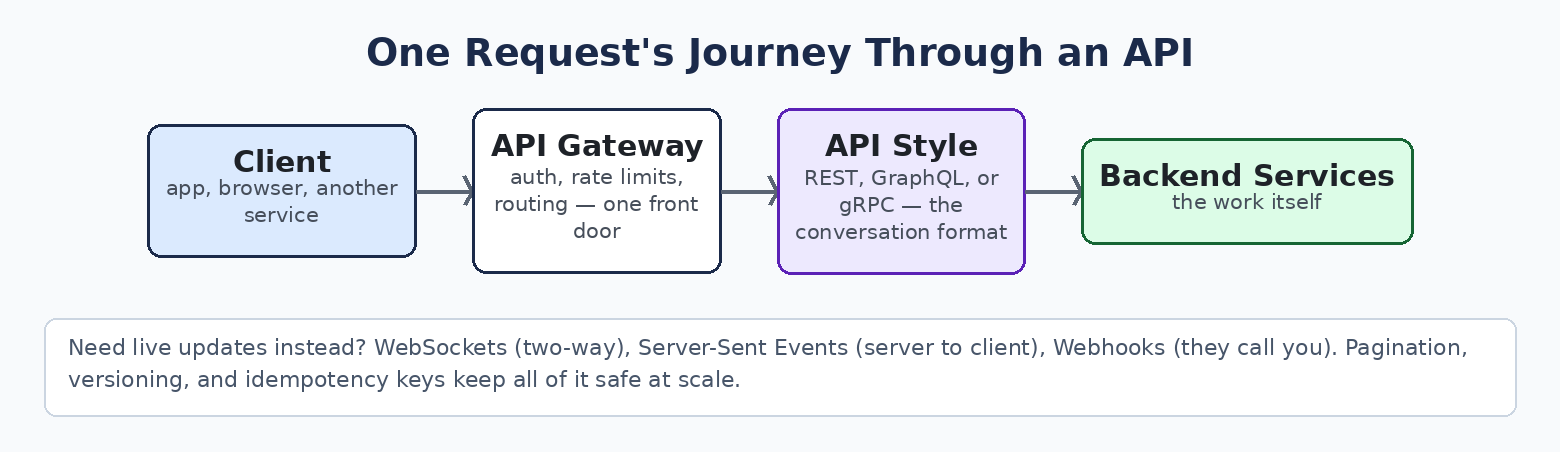
The three conversation styles
1. REST. Resources as URLs, acted on with HTTP verbs: GET /orders/42 reads one, POST /orders creates one, PUT replaces, DELETE removes. It is the default because it is simple, cacheable, and every developer alive already speaks it.
2. GraphQL. One endpoint; the client sends a query naming exactly the fields it wants, and gets exactly those back — no more, no less. It ends over-fetching and under-fetching, and it shines when many different clients (web, iOS, Android) need different shapes of the same data.
3. gRPC. Remote function calls over HTTP/2 using Protobuf — a compact binary format with a strict contract. Faster and smaller than JSON, made for service-to-service traffic inside your system, where browsers are not involved.
Rule of thumb: REST for public APIs, GraphQL for client-driven data needs, gRPC between your own services.
The three ways to push
4. WebSockets. One connection, upgraded from HTTP, kept open for messages in both directions. Chat, live dashboards, games — anything where the client also talks back constantly.
5. Webhooks. The provider calls your URL when something happens: payment completed, build finished, shipment moved. They call you, so you never poll. If your design has a loop asking “is it ready yet?”, a webhook probably deletes it.
6. Server-Sent Events (SSE). A one-way stream from server to client over plain HTTP. Simpler than WebSockets when the client only listens — notifications, feeds, and the token-by-token streaming of LLM responses, which is exactly how most AI chat products work under the hood.
The five that keep you safe at scale
7. Pagination. Never return a list unbounded. Return a page (say 20 items) plus a cursor pointing at the next page. Cursors beat page numbers because they stay correct while data changes underneath.
8. Rate Limiting. A cap per client per window — 100 requests a minute, say. Under the limit, requests pass; over it, a 429 and a “retry later.” It protects the service from abuse, accidents, and any single customer becoming everyone’s outage.
9. Idempotency Keys. The client attaches a unique key to a request. First arrival: do the work (charge the card), save the result against the key. A retry with the same key: skip the work, return the saved result. This one header is what makes retries — and payments — safe.
10. Versioning. Ship breaking changes as /v2/ while /v1/ keeps running, retire v1 only when clients have migrated. Versioning is how an API evolves without breaking the people who trusted it.
11. OAuth / JWT. OAuth handles permission (a user lets an app act on their behalf); the JWT is the signed token that proves who is calling and what they may do, checked by the API on every request without a database lookup.
12. API Gateway. One entry point in front of many services: authentication, rate limits, routing, and logging in a single place, so every service behind it does not reinvent them. Clients see one door; you operate a building.
The bottom line
Pick the conversation style by who is talking (public, client-driven, or internal), the push mechanism by direction (both ways, event-driven, or listen-only), and treat pagination, rate limiting, idempotency, versioning, and the gateway as non-negotiable from day one. Retrofitting any of them costs ten times what designing them in does.
Building APIs or AI platforms that have to survive production? The free architecture toolkits go one layer deeper.

