Tag: Script

  • ORIGINAL_LOGIN() and SUSER_SNAME() functions

    ORIGINAL_LOGIN() function returns the name of the original login that connected to the instance of SQL Server and is used to identify original login in all sessions. Even though you will do the security context switch it will return the original login name.

    SUSER_SNAME returns the name of user in the current security context.

    --connect SQL Using LoginDEMO account
    SELECT ORIGINAL_LOGIN() Original_Login_func, SUSER_SNAME() Suser_Name_Login_Func
    
    --Executing query using LoginTest account
    execute as login = 'LoginTest'
    SELECT ORIGINAL_LOGIN() Original_Login_func, SUSER_SNAME() Suser_Name_Login_Func
    revert
    
    --Again executing query be reverting the change
    SELECT ORIGINAL_LOGIN() Original_Login_func, SUSER_SNAME() Suser_Name_Login_Func
    

    Check below output image for more information. I connected SQL Server using LoginDemo account.
    New

  • Script to get the database backup history

    For the point time recovery or in case of failure it is essential that you should have the backup history of the database. You can execute the below query against the database to get the backup history.

    SELECT  
       CONVERT(CHAR(100), SERVERPROPERTY('Servername')) AS Server, 
       msdb.dbo.backupset.database_name,  
       msdb.dbo.backupset.backup_start_date,  
       msdb.dbo.backupset.backup_finish_date, 
       msdb.dbo.backupset.expiration_date, 
       CASE msdb..backupset.type  
           WHEN 'D' THEN 'Database'  
           WHEN 'L' THEN 'Log'  
       END AS backup_type,  
       msdb.dbo.backupmediafamily.logical_device_name,  
       msdb.dbo.backupmediafamily.physical_device_name,   
       msdb.dbo.backupset.name AS backupset_name, 
       msdb.dbo.backupset.description 
    FROM   msdb.dbo.backupmediafamily  
       INNER JOIN msdb.dbo.backupset ON msdb.dbo.backupmediafamily.media_set_id = msdb.dbo.backupset.media_set_id 
    WHERE 
    (CONVERT(datetime, msdb.dbo.backupset.backup_start_date, 102) >= '2013-01-08 00:04:49.000')  and (CONVERT(datetime, msdb.dbo.backupset.backup_start_date, 102) <= '2013-01-08 23:59:59')  
    and  msdb.dbo.backupset.database_name = 'Mention the database name'
    ORDER BY  
       msdb.dbo.backupset.backup_finish_date desc
    
  • sys.dm_server_registry

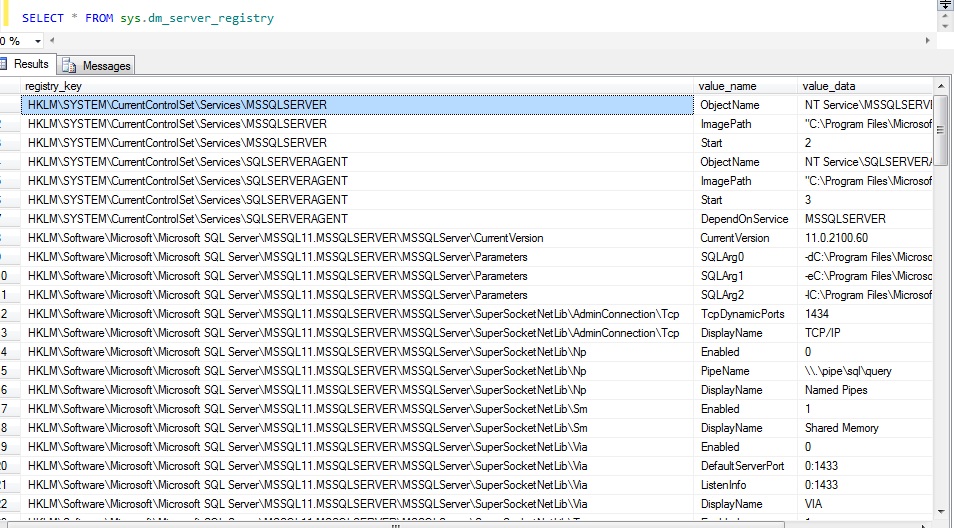
    sys.dm_server_registry DMV gives information about installation and configuration data that is stored in the windows registry for the current instance of SQL server.

    You can use to check the start up parameters, protocols, error log configuration, agent log configuration and IP Addresses.

    SQLReg

  • Script to check the database Properties

    It is always good to have the idea about the database properties while doing the migration, performance tuning or configuration.

    You can execute the below script to get the database property information.

    select 
     sysDB.database_id,
     sysDB.Name as 'Database Name',
     syslogin.Name as 'DB Owner',
     sysDB.state_desc,
     sysDB.recovery_model_desc,
     sysDB.collation_name, 
     sysDB.user_access_desc,
     sysDB.compatibility_level, 
     sysDB.is_read_only,
     sysDB.is_auto_close_on,
     sysDB.is_auto_shrink_on,
     sysDB.is_auto_create_stats_on,
     sysDB.is_auto_update_stats_on,
     sysDB.is_fulltext_enabled,
     sysDB.is_trustworthy_on
    from sys.databases sysDB
    INNER JOIN sys.syslogins syslogin ON sysDB.owner_sid = syslogin.sid
    
  • Steps to Check the Host Name for a Clustered SQL Server Instance

    Problem
    While troubleshooting a SQL Server cluster failover issue, it is essential to know the time needed for the cluster failover and the node name where SQL Server was running before the failover occurred. In this tip, I will show you the different options to find the failover time and node name where SQL Server was running before the failover over.

    Solution
    http://www.mssqltips.com/sqlservertip/2744/steps-to-check-the-host-name-for-a-clustered-sql-server-instance/