
Every modern system — and every AI product built on one — is a stack of nine layers. Tools change every year; the layers barely do. Learn the layers and you can walk into any architecture diagram, any vendor pitch, any design review, and know exactly where you are standing.
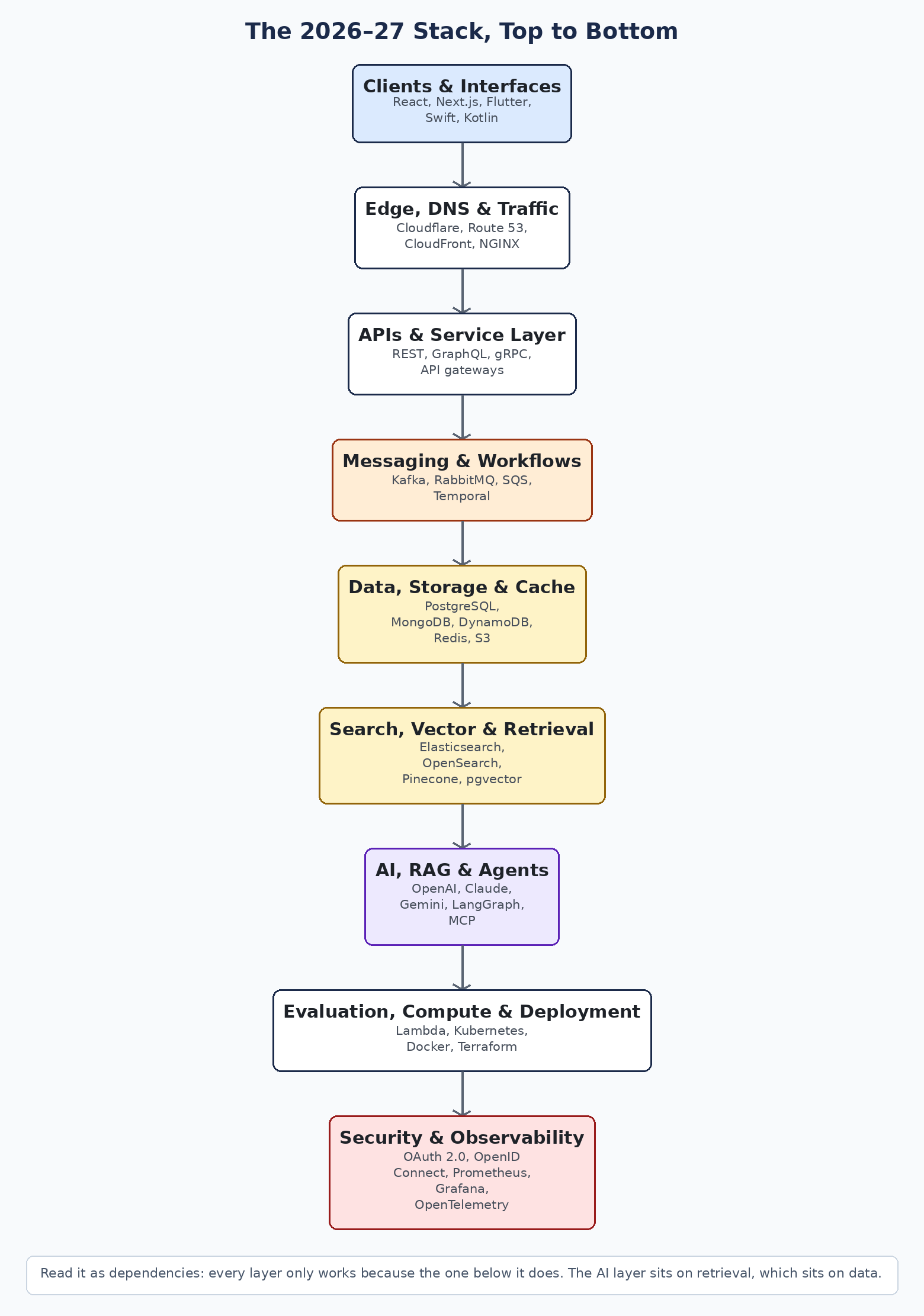
1. Clients & Interfaces. What the user touches: web apps (React, Next.js), mobile (Flutter, Swift, Kotlin, React Native). This layer decides nothing about scale — but everything about perceived speed.
2. Edge, DNS & Traffic. How requests find you and get close to the user: DNS (Route 53), CDNs and edge networks (Cloudflare, CloudFront), and the proxies (NGINX, HAProxy, Envoy) that terminate and route traffic. Geography is latency; this layer is where you cheat geography.
3. APIs & Service Layer. The contracts everything speaks: REST, GraphQL, gRPC — fronted by API gateways (Kong, Apigee, AWS API Gateway) that own authentication, rate limiting, and routing once, for every service behind them.
4. Messaging & Workflows. How services talk without waiting on each other: Kafka, RabbitMQ, SQS, NATS, Pulsar for events and queues; Temporal for long-running workflows that must survive failures. This is the layer that turns a fragile chain of calls into a resilient flow.
5. Data, Storage & Cache. The ground everything stands on: relational (PostgreSQL, MySQL), document and NoSQL (MongoDB, DynamoDB), object storage (S3), and cache (Redis) for the reads that cannot afford a database trip. Choose by access pattern, not by habit.
6. Search, Vector & Retrieval. Finding things by meaning, not just by key: Elasticsearch and OpenSearch for text search; Milvus, Pinecone, Weaviate, and pgvector for embeddings. This layer did not exist in most stacks five years ago; it is now where AI systems live or die, because retrieval quality is answer quality.
7. AI, RAG & Agents. The models (OpenAI, Claude, Gemini) and the frameworks that wire them to your data and tools: LangGraph, LlamaIndex, and MCP — the protocol becoming the standard way agents connect to tools. Notice where this layer sits: seventh, not first. It is powerful precisely because the six layers beneath it are solid.
8. Evaluation, Compute & Deployment. Where everything runs and how you know it works: Lambda and Cloud Run for serverless, Kubernetes and Docker for containers, Terraform and GitHub Actions for the pipeline. For AI systems this layer also carries evaluation — the checks that prove a model change helped instead of quietly hurting.
9. Security & Observability. The layer that wraps all the others: OAuth 2.0 and OpenID Connect for identity, Vault for secrets, and Prometheus, Grafana, Datadog, and OpenTelemetry so you can see what the system is actually doing. If you cannot observe it, you do not operate it — you hope.
How to use this map
When a system misbehaves, locate the layer before reaching for a fix — most “AI problems” are retrieval problems (layer 6) or data problems (layer 5) wearing a model costume. When a vendor pitches you, ask which layer they replace and which layers they assume you already have. And when you design something new, walk the stack top to bottom and make one deliberate choice per layer.
The bottom line
Products are built from tools, but architectures are built from layers. Master the nine layers and the tool names — which will keep changing — become the easy part.
The free toolkits include the AI Engineering Iceberg Poster — the same idea, drawn for the AI stack specifically.

