
Most organizations treat AI risk as a compliance checkbox — a review board, a form, a sign-off. That is backwards.
I believe AI risk management should be embedded into the enterprise architecture and the delivery lifecycle, not treated as a separate compliance activity. When risk controls live inside the architecture, teams move fast by default and slow down only where it matters.
Here is the whole framework in five letters: R-I-S-K-S.
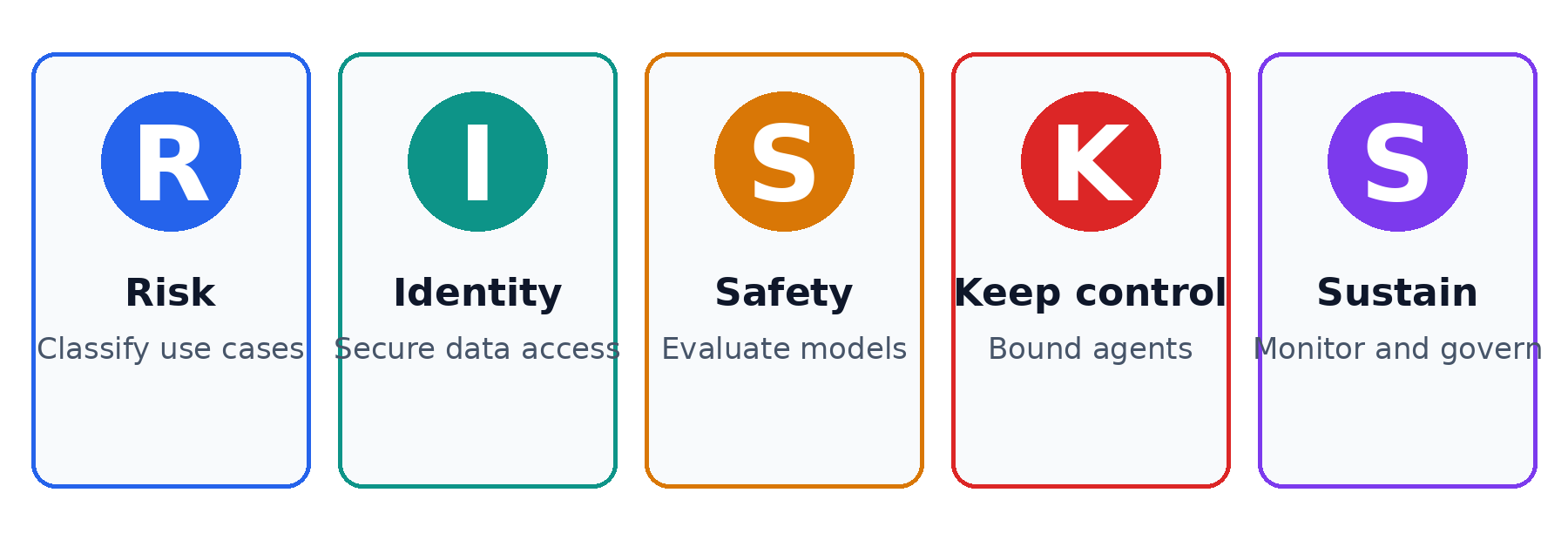
R — Risk: classify use cases
Not every AI use case carries the same risk. A knowledge assistant summarizing internal policies is not the same as an agent recommending manufacturing quality decisions or initiating financial transactions.
Classify every application on four axes: data sensitivity, business criticality, autonomy, and regulatory impact. The classification decides everything downstream — which controls apply, who reviews, how fast it ships.
I — Identity: secure data access
Trusted data access, data classification, least-privilege permissions, encryption, lineage, auditability.
For RAG applications, one rule matters most: enforce document-level authorization before retrieval reaches the LLM. The model should never see what the user is not entitled to see.
S — Safety: evaluate models
Evaluation frameworks that measure accuracy, hallucinations, bias, groundedness, and robustness — where each is relevant.
These evaluations belong in CI/CD release gates, backed by versioned datasets and ongoing production monitoring. If you cannot measure it, you cannot ship it.
K — Keep control: bound agents
Moving from AI-generated recommendations to agents taking actions is where risk jumps. Deterministic orchestration for business-critical workflows. Tools restricted through explicit authorization. Human approval required for high-impact decisions.
Agents operate within clearly defined boundaries. Outside those boundaries, the agent does not exist.
S — Sustain: monitor and govern
AI observability. Incident response. Model and prompt versioning. Rollback capabilities. Vendor risk management. Clear accountability across architecture, security, compliance, and business owners.
This is the dimension that keeps the other four honest in production.
How to apply it
Implement these controls through a risk-based governance framework — not the same review process for every application. Low-risk use cases move fast. High-impact ones get the full treatment.
The objective: an environment where business teams innovate quickly, and security, compliance, reliability, and accountability are built into the architecture from day one.
My philosophy, in one line: AI innovation and AI governance should not compete. The right architecture enables both. Move quickly where the risk is low, apply stronger controls where the impact is high, and always preserve human accountability for consequential decisions.
The framework to memorize: R-I-S-K-S.


Thanks for the comment, will get back to you soon… Jugal Shah