
Every food order, cab ride, payment, and delivery tracking screen you have ever watched was powered by events moving between systems. Kafka is the backbone most of those systems chose. Twelve concepts explain nearly all of it — and they build on each other in order.
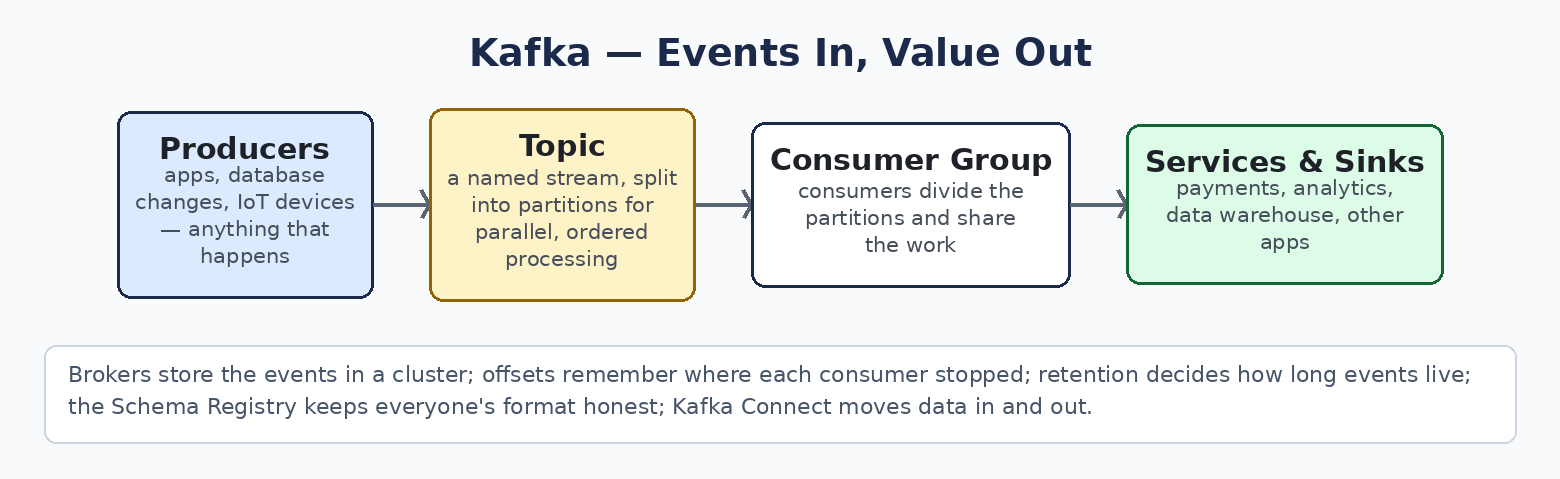
1. Producer. Anything that creates events: an app, a database change, an IoT sensor. A producer’s whole job is to fire events into Kafka, continuously, and move on — it never waits for whoever will use them.
2. Topic. A named stream of related events — orders, payments, clicks. Topics are how Kafka organizes the firehose into channels with meaning.
3. Partition. Each topic is split into partitions — parallel lanes. Partitions are where Kafka’s scale comes from (many consumers can read different lanes at once) and where ordering lives: events are ordered within a partition, not across the whole topic.
4. Consumer. A service that reads events from topics and does work with them — updates inventory, sends the notification, writes to the warehouse.
5. Consumer Group. Consumers working as a team. Kafka divides the topic’s partitions among the group’s members, so adding consumers adds parallel processing — up to the number of partitions, which is why partition count is a design decision, not a detail.
6. Broker. A Kafka server. It receives events from producers, stores them, and serves them to consumers.
7. Cluster. Many brokers working as one system. The cluster is what gives Kafka its scale (spread the load) and its resilience (survive losing machines).
8. Offset. A bookmark. Every event in a partition has a position number, and each consumer group remembers its offset — where it stopped reading. Crash, restart, redeploy: the consumer resumes from its offset instead of starting over or losing events.
9. Replication. Partitions are copied across brokers. If the broker holding a partition dies, a replica takes over and no data is lost. Replication is the difference between “event streaming” and “event streaming you can run a bank on.”
10. Retention. Kafka does not delete an event after it is read. It keeps events for a configured time (or size) — seven days, say — so a new consumer can replay history, and a broken one can catch up. This single property separates Kafka from ordinary message queues.
11. Schema Registry. The contract office. Producers and consumers register the exact format of their events, so a producer cannot silently change a field and break fifty downstream consumers at 3 AM.
12. Kafka Connect. Prebuilt bridges that move data between Kafka and the outside world — databases in, warehouses and SaaS apps out — without hand-written producer and consumer code for every source and sink.
The one-sentence version
Producers write events into partitioned topics stored across a replicated cluster of brokers; consumer groups read them in parallel, track their place with offsets, keep them as long as retention allows, and trust the Schema Registry and Connect to keep the whole ecosystem honest and connected.
Remember that sentence and you understand Kafka well enough to design with it. Everything else is tuning.
Streaming is one layer of the modern data stack — the free toolkits map the rest.


Thanks for the comment, will get back to you soon… Jugal Shah