
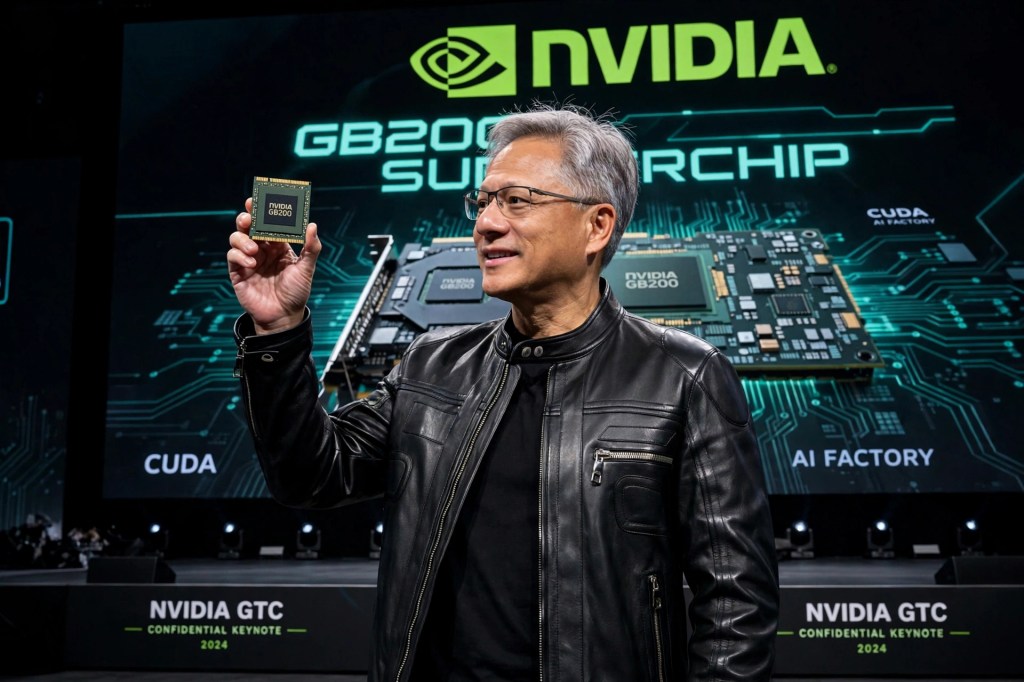
On November 12, 2026, after 33 years, Jensen Huang resigned as NVIDIA’s president and CEO, effective immediately. The ending is abrupt. The journey is still worth telling — because no one else built the future the way he did.
I am writing this as an architect, to an architect. Not a eulogy. A thank-you.
1. Denny’s, 1993 — the bet
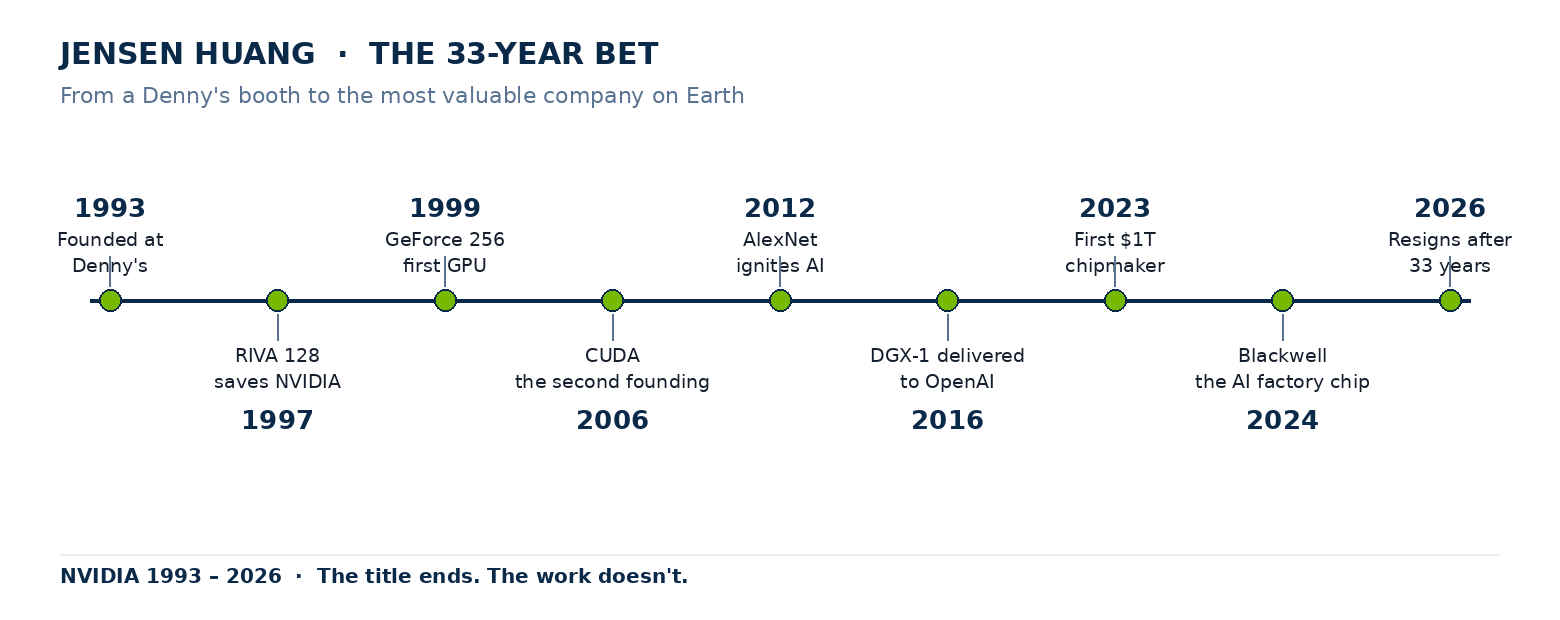
Jensen washed dishes at a Denny’s as a teenager. At thirty, he sat in a Denny’s in San Jose with two engineers, Chris Malachowsky and Curtis Priem, and founded NVIDIA with $40,000. The bet: dedicated graphics chips would matter more than the general-purpose CPU. Everyone else was chasing CPUs. He bet the other way.
2. Near-death, 1995–97 — the humility
NVIDIA’s first chip, the NV1, failed. The company cut its staff roughly in half and was months from dying. Jensen went to Sega, admitted the architecture was the wrong path, and asked them to pay out the contract anyway. They did — $5 million, six more months of life. In six months NVIDIA built the RIVA 128, sold a million units in four months, and survived. His own lesson, told to graduates in 2023: confronting the mistake, with humility, saved NVIDIA.
3. CUDA, 2006 — the best product
If NVIDIA has one best product, it is not a chip. It is CUDA.
In 2006, NVIDIA let anyone program its graphics chips for general maths — not just games. Wall Street saw an expensive hobby with no revenue. Jensen saw the future: parallel computing as a general-purpose resource. The bet waited a decade to pay. In 2012, AlexNet — trained on NVIDIA GPUs — won the ImageNet competition and ignited deep learning. Everything since, every model you have used, runs on the road CUDA built.
And the hardware cashing that bet today is Blackwell. Announced in March 2024, the B200 ships as racks of 72 GPUs joined by NVLink — the engine of the AI factories. CUDA wrote the future; Blackwell is building it at scale. The hardware crown and the software foundation, one bet, eighteen years apart.
4. The delivery, 2016 — the hand-off
In August 2016, Jensen personally drove the first DGX-1 — an AI supercomputer in a box, eight GPUs, $129,000 — to a tiny lab called OpenAI, and signed it by hand. Six years later that lab shipped ChatGPT, and the world changed overnight. Visionaries don’t just predict the future. They hand-deliver the tools for it.
5. The world catches up, 2023 — the trillion
In May 2023, NVIDIA became the first chipmaker worth $1 trillion. In 2024 it briefly became the most valuable company on Earth. By October 2025 it was the first company in history worth $5 trillion. The market finally priced what Jensen had seen in a Denny’s booth in 1993.
What he taught us
Run, don’t walk. Bet on the future before it is obvious. Admit the mistake, ask for help, and build again. The title ends. The work doesn’t.
Thank you, Jensen. The future you built is still running.
Facts: founded April 5, 1993 (Denny’s, San Jose); NV1 1995, RIVA 128 August 1997; GeForce 256, October 1999 — marketed as the world’s first GPU; CUDA introduced November 2006; AlexNet 2012; DGX-1 delivered to OpenAI August 2016; $1 trillion market value May 30, 2023; Blackwell announced March 18, 2024 (B200; racks of 72 GPUs joined by NVLink); $5 trillion October 29, 2025; resigned November 12, 2026, Colette Kress interim CEO. Sources: NVIDIA’s own releases, Reuters, USA Today, Le Monde.


Thanks for the comment, will get back to you soon… Jugal Shah