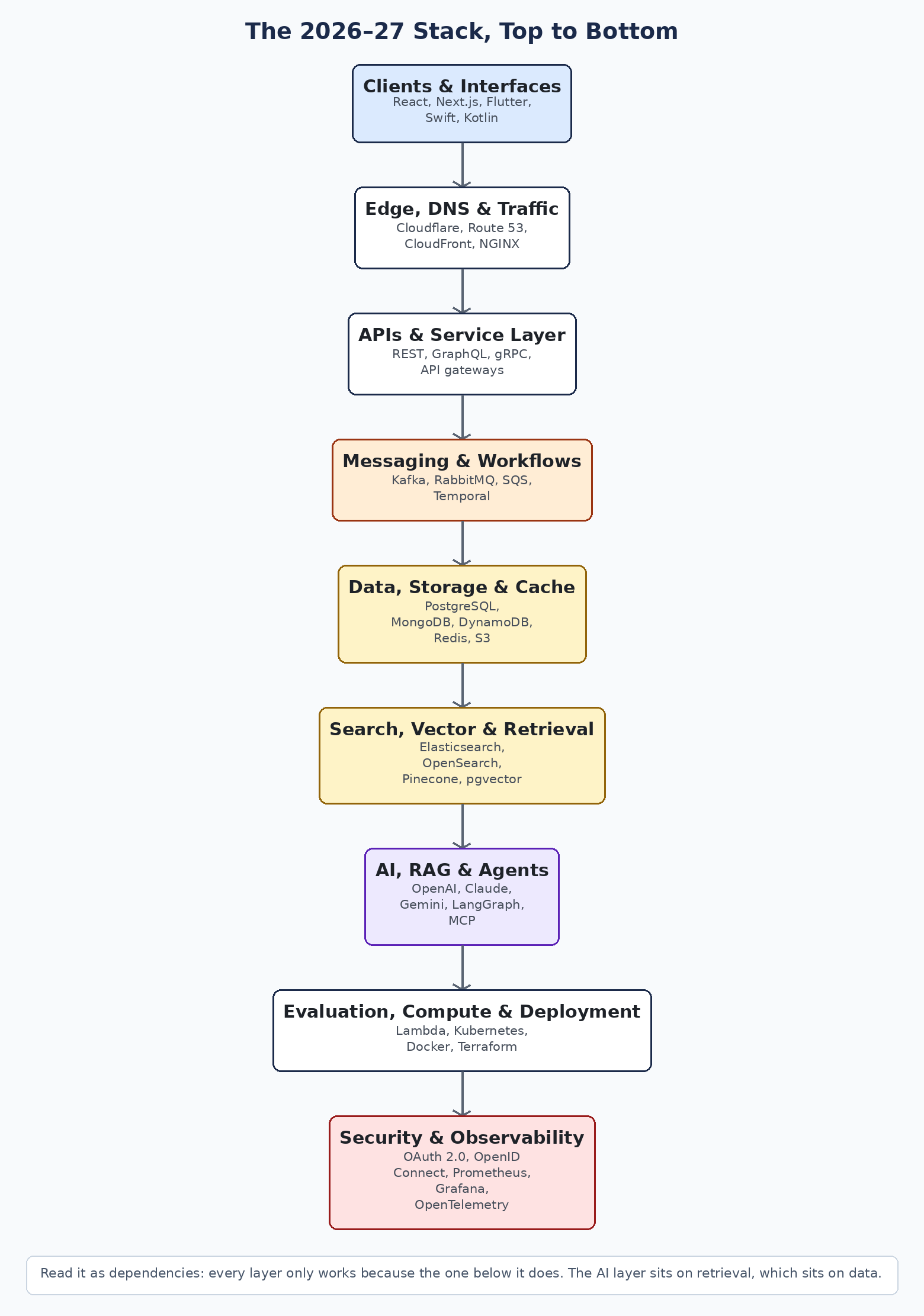
Every modern system — and every AI product built on one — is a stack of nine layers. Tools change every year; the layers barely do. Learn the layers and you can walk into any architecture diagram, any vendor pitch, any design review, and know exactly where you are standing.
1. Clients & Interfaces. What the user touches: web apps (React, Next.js), mobile (Flutter, Swift, Kotlin, React Native). This layer decides nothing about scale — but everything about perceived speed.
2. Edge, DNS & Traffic. How requests find you and get close to the user: DNS (Route 53), CDNs and edge networks (Cloudflare, CloudFront), and the proxies (NGINX, HAProxy, Envoy) that terminate and route traffic. Geography is latency; this layer is where you cheat geography.
3. APIs & Service Layer. The contracts everything speaks: REST, GraphQL, gRPC — fronted by API gateways (Kong, Apigee, AWS API Gateway) that own authentication, rate limiting, and routing once, for every service behind them.
4. Messaging & Workflows. How services talk without waiting on each other: Kafka, RabbitMQ, SQS, NATS, Pulsar for events and queues; Temporal for long-running workflows that must survive failures. This is the layer that turns a fragile chain of calls into a resilient flow.
5. Data, Storage & Cache. The ground everything stands on: relational (PostgreSQL, MySQL), document and NoSQL (MongoDB, DynamoDB), object storage (S3), and cache (Redis) for the reads that cannot afford a database trip. Choose by access pattern, not by habit.
6. Search, Vector & Retrieval. Finding things by meaning, not just by key: Elasticsearch and OpenSearch for text search; Milvus, Pinecone, Weaviate, and pgvector for embeddings. This layer did not exist in most stacks five years ago; it is now where AI systems live or die, because retrieval quality is answer quality.
7. AI, RAG & Agents. The models (OpenAI, Claude, Gemini) and the frameworks that wire them to your data and tools: LangGraph, LlamaIndex, and MCP — the protocol becoming the standard way agents connect to tools. Notice where this layer sits: seventh, not first. It is powerful precisely because the six layers beneath it are solid.
8. Evaluation, Compute & Deployment. Where everything runs and how you know it works: Lambda and Cloud Run for serverless, Kubernetes and Docker for containers, Terraform and GitHub Actions for the pipeline. For AI systems this layer also carries evaluation — the checks that prove a model change helped instead of quietly hurting.
9. Security & Observability. The layer that wraps all the others: OAuth 2.0 and OpenID Connect for identity, Vault for secrets, and Prometheus, Grafana, Datadog, and OpenTelemetry so you can see what the system is actually doing. If you cannot observe it, you do not operate it — you hope.
How to use this map
When a system misbehaves, locate the layer before reaching for a fix — most “AI problems” are retrieval problems (layer 6) or data problems (layer 5) wearing a model costume. When a vendor pitches you, ask which layer they replace and which layers they assume you already have. And when you design something new, walk the stack top to bottom and make one deliberate choice per layer.
The bottom line
Products are built from tools, but architectures are built from layers. Master the nine layers and the tool names — which will keep changing — become the easy part.
The free toolkits include the AI Engineering Iceberg Poster — the same idea, drawn for the AI stack specifically.
This is the most argued decision in software architecture, and most teams make it for the wrong reason — fashion, a conference talk, or a resume. The honest version is simpler: a monolith is one application that deploys together; microservices are many small applications that deploy independently. Everything else follows from that.
The two shapes
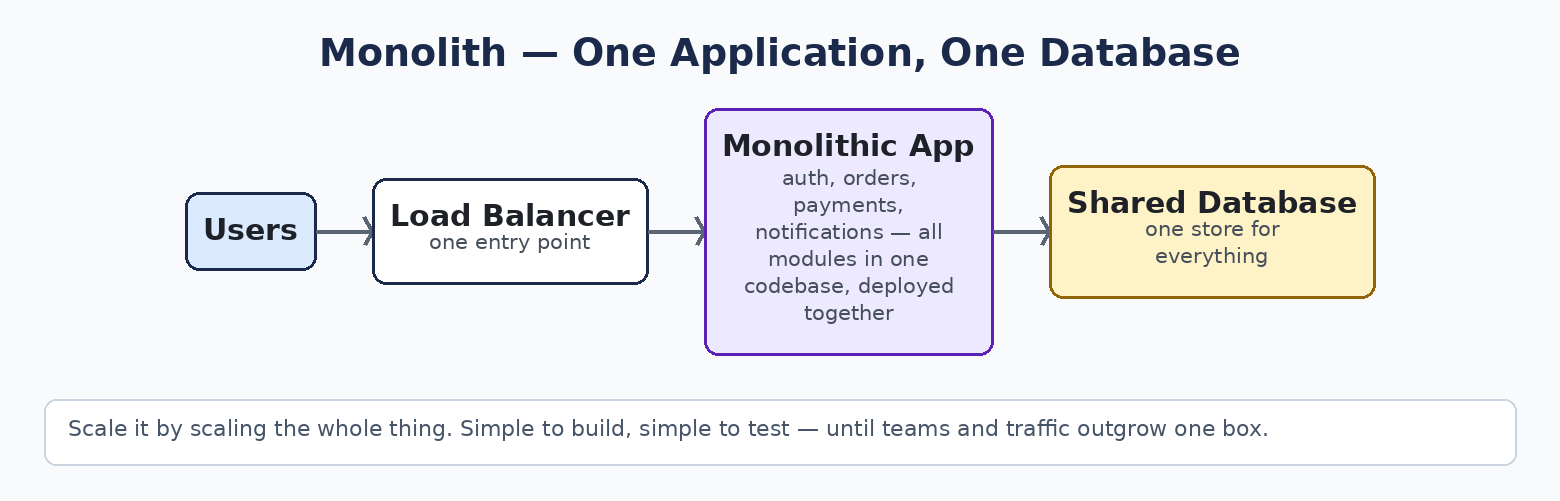
Monolith. All modules — auth, orders, payments, notifications — live in one codebase, deploy as one unit, and usually share one database. A request travels inside a single process: function calls, not network calls.
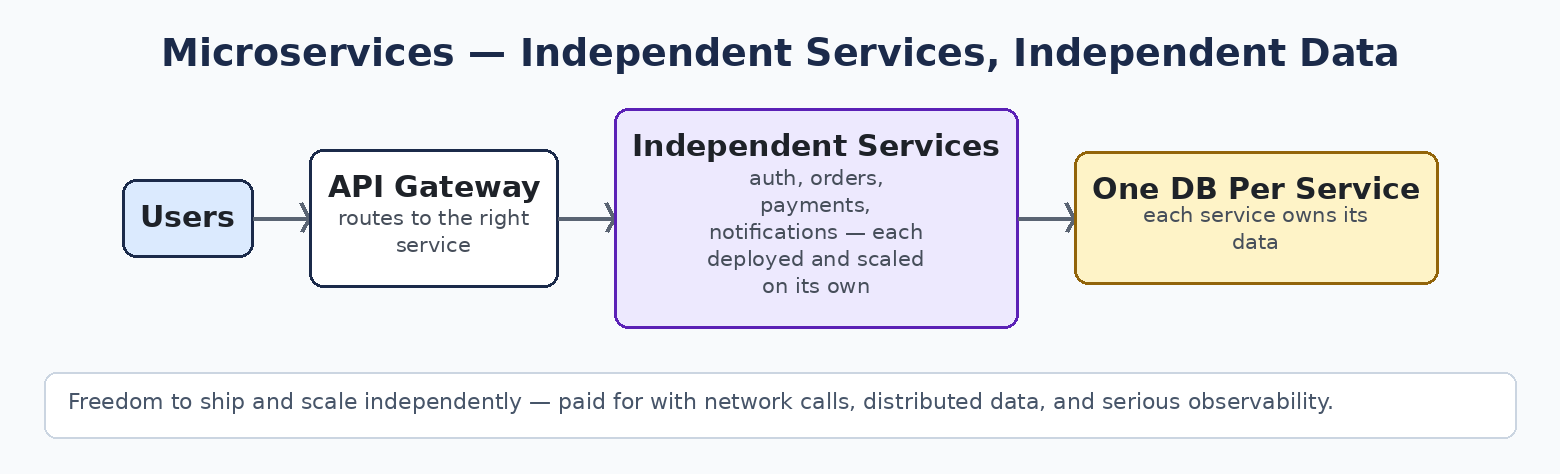
Microservices. The application is split by business capability. Each service owns one job, its own codebase, its own deployment pipeline, and its own database. Services talk through APIs and events.
Side by side
Feature
Monolith
Microservices
Codebase
One
One per service
Deployment
Everything together
Each service independently
Scaling
Scale the whole app
Scale only the hot service
Coupling
Tight — modules touch directly
Loose — contracts between services
Data
Usually one shared database
Decentralized, per service
Fault isolation
One failure can take the app down
Failures can be contained
Development speed
Fast early
Faster for many large teams
Testing
Simpler end-to-end
Complex integration testing
Operations
Easy to run
Demands automation + observability
Best for
Small/medium apps, early products
Large, complex platforms
When each one wins
Choose a monolith when the team is small, the domain is still being discovered, and speed of change matters more than independent scale. Most products should start here: you can refactor a working monolith; you cannot refactor a distributed system you did not need into existence.
Choose microservices when the pain is real and named: teams stepping on each other’s releases, one module needing 50× the scale of the rest, or independent deployment becoming a business requirement. Microservices trade code complexity for organizational scalability — that is the actual product you are buying.
The analogy that settles it
A monolith is a department store: everything under one roof, one management, easy to run — and a fire anywhere can close the whole store. Microservices are a shopping complex: specialized stores, each opening, closing, and expanding on its own — and now somebody has to run the mall: security, utilities, parking, signs. Neither is “better.” They are answers to different sizes of problem.
The bottom line
Start simple. Earn the complexity. Move to microservices when scale, team autonomy, and independent deployment become real needs with names and numbers — not when a blog post says monoliths are dead. The best architecture is the one your team can actually operate at 2 AM.
More architecture decisions, made the same honest way: the free toolkits and posters collect them.
APIs are contracts. Once clients depend on one, every careless choice becomes permanent — you can add almost anything, but you can remove almost nothing. These twelve concepts are the difference between an API that scales gracefully and one that becomes the bottleneck in every meeting.
The three conversation styles
1. REST. Resources as URLs, acted on with HTTP verbs: GET /orders/42 reads one, POST /orders creates one, PUT replaces, DELETE removes. It is the default because it is simple, cacheable, and every developer alive already speaks it.
2. GraphQL. One endpoint; the client sends a query naming exactly the fields it wants, and gets exactly those back — no more, no less. It ends over-fetching and under-fetching, and it shines when many different clients (web, iOS, Android) need different shapes of the same data.
3. gRPC. Remote function calls over HTTP/2 using Protobuf — a compact binary format with a strict contract. Faster and smaller than JSON, made for service-to-service traffic inside your system, where browsers are not involved.
Rule of thumb: REST for public APIs, GraphQL for client-driven data needs, gRPC between your own services.
The three ways to push
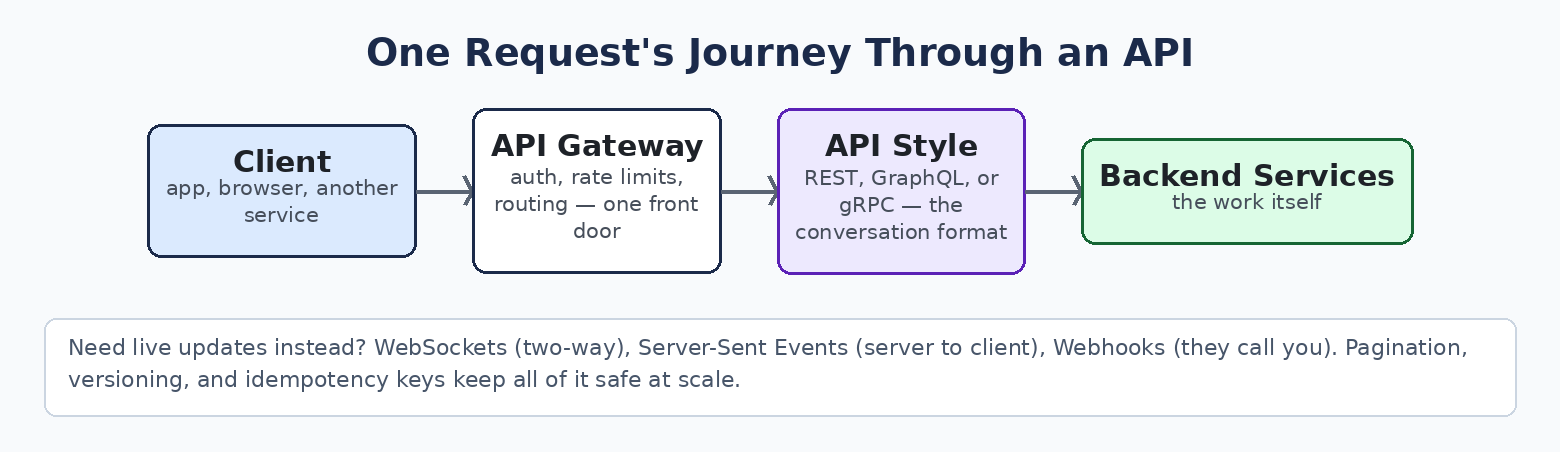
4. WebSockets. One connection, upgraded from HTTP, kept open for messages in both directions. Chat, live dashboards, games — anything where the client also talks back constantly.
5. Webhooks. The provider calls your URL when something happens: payment completed, build finished, shipment moved. They call you, so you never poll. If your design has a loop asking “is it ready yet?”, a webhook probably deletes it.
6. Server-Sent Events (SSE). A one-way stream from server to client over plain HTTP. Simpler than WebSockets when the client only listens — notifications, feeds, and the token-by-token streaming of LLM responses, which is exactly how most AI chat products work under the hood.
The five that keep you safe at scale
7. Pagination. Never return a list unbounded. Return a page (say 20 items) plus a cursor pointing at the next page. Cursors beat page numbers because they stay correct while data changes underneath.
8. Rate Limiting. A cap per client per window — 100 requests a minute, say. Under the limit, requests pass; over it, a 429 and a “retry later.” It protects the service from abuse, accidents, and any single customer becoming everyone’s outage.
9. Idempotency Keys. The client attaches a unique key to a request. First arrival: do the work (charge the card), save the result against the key. A retry with the same key: skip the work, return the saved result. This one header is what makes retries — and payments — safe.
10. Versioning. Ship breaking changes as /v2/ while /v1/ keeps running, retire v1 only when clients have migrated. Versioning is how an API evolves without breaking the people who trusted it.
11. OAuth / JWT. OAuth handles permission (a user lets an app act on their behalf); the JWT is the signed token that proves who is calling and what they may do, checked by the API on every request without a database lookup.
12. API Gateway. One entry point in front of many services: authentication, rate limits, routing, and logging in a single place, so every service behind it does not reinvent them. Clients see one door; you operate a building.
The bottom line
Pick the conversation style by who is talking (public, client-driven, or internal), the push mechanism by direction (both ways, event-driven, or listen-only), and treat pagination, rate limiting, idempotency, versioning, and the gateway as non-negotiable from day one. Retrofitting any of them costs ten times what designing them in does.
Building APIs or AI platforms that have to survive production? The free architecture toolkits go one layer deeper.
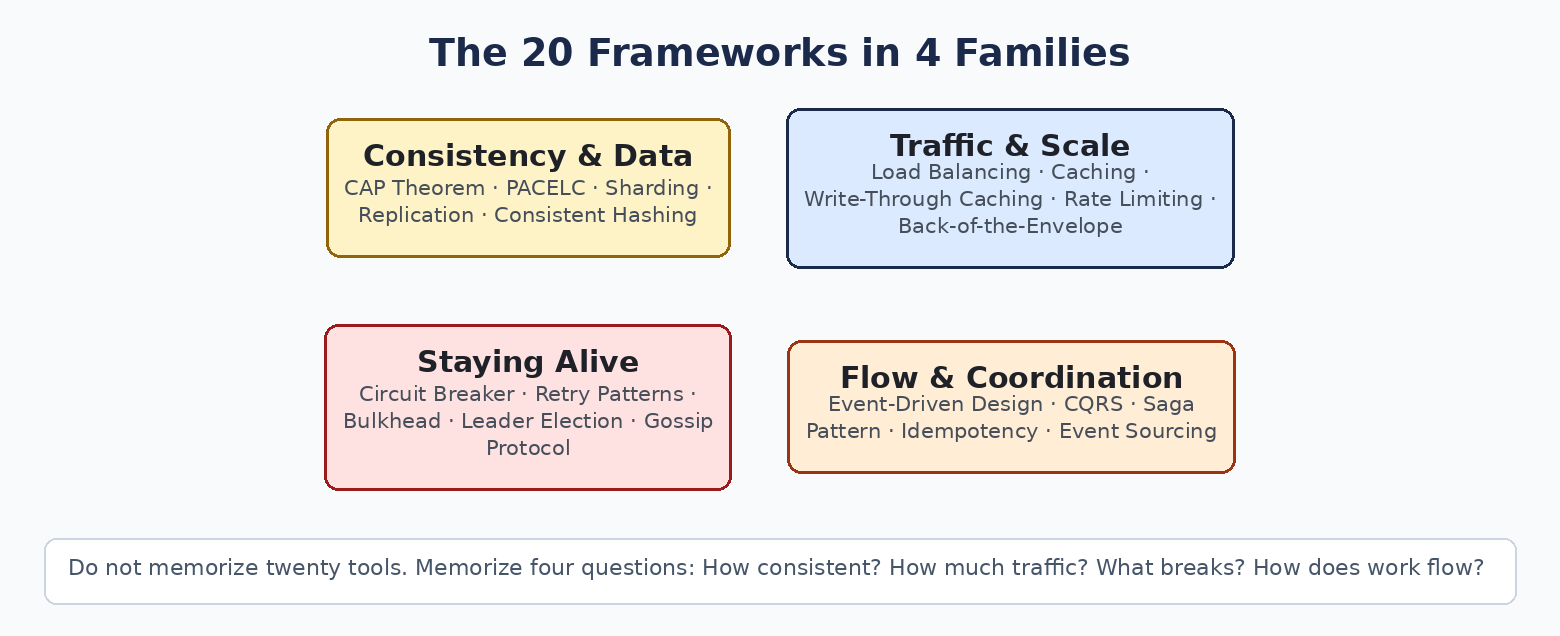
Twenty frameworks is a lot to memorize — until you notice they are answers to only four questions. How consistent must the data be? How much traffic is coming? What happens when something breaks? And how should work flow between services?
Sort the twenty into those four families and the list stops being a list. It becomes a checklist you can run in any design review.
Family 1: Consistency & Data — “What is the truth, and where does it live?”
CAP Theorem. When a network partition splits your system, you must choose: stay consistent (every read sees the latest write) or stay available (every request gets an answer, possibly stale). You cannot have both during a partition. This is the first fork in every distributed design.
PACELC Model. CAP only speaks during failures. PACELC adds the everyday case: else (no partition), you still trade Latency against Consistency. It is CAP for real life, because most days nothing is broken — and you are still making the trade.
Database Sharding. Split one large dataset across many databases — by user ID, by region, by any key that spreads the load evenly. Reach for it when a single database genuinely cannot carry the workload, not before.
Replication. Copy data across nodes so the system survives losing one. Leader–follower when one writer is enough; multi-leader when writes must happen in more than one place. Replication buys reliability and read scale; it charges you in consistency headaches.
Consistent Hashing. The ring that decides which node owns which key — designed so that adding or removing a node moves only a small slice of the data, not everything. It is why sharded systems can scale without a weekend of rebalancing.
Family 2: Traffic & Scale — “Too many requests, not enough server”
Load Balancing. Spread incoming traffic across servers: round-robin for simple cases, least-connections when requests vary, hashing when a user must land on the same node. The goal is boring — no server drowning while its neighbor idles.
Caching Strategies. Keep frequently read data close and fast. Cache-aside (the app checks the cache, fills it on a miss), write-through, write-back — the variations are about when the cache and the database agree.
Write-Through Caching. The specific pattern worth naming on its own: every write updates the cache and the database together, so the cache is never stale. You pay a little write latency to buy reads you can trust.
Rate Limiting. Cap how many requests a client may make in a window. It protects availability, enforces fairness between customers, and turns abuse into a polite 429 instead of an outage.
Back-of-the-Envelope Estimation. Rough capacity math with stated assumptions: users × requests × size = storage, bandwidth, servers. Five minutes of arithmetic that kills unbuildable designs before they consume a quarter.
Family 3: Staying Alive — “Something will fail; then what?”
Circuit Breaker. When a downstream service keeps failing, stop calling it for a while — fail fast, let it recover, test it with a trickle before reopening the floodgates. Named after the electrical part because it does the same job: it keeps a fault from burning down the house.
Retry Patterns. Failed requests often succeed on a second attempt — but retry with exponential backoff and jitter, or a thousand clients retrying in lockstep become the outage.
Bulkhead Pattern. Partition your own resources the way a ship’s hull is partitioned: separate thread pools per dependency, so one slow service floods only its own compartment instead of sinking the whole application.
Leader Election. In a cluster, exactly one node coordinates. Leader election picks that node dynamically and replaces it when it dies — the quiet mechanism behind half the systems in this list.
Gossip Protocol. Nodes spread state by chatting with random peers, the way news spreads through an office. No central coordinator, no bottleneck — large clusters stay informed eventually, which is usually enough.
Family 4: Flow & Coordination — “How does work move and stay correct?”
Event-Driven Design. Services react to events instead of calling each other directly. The producer does not know or care who consumes — which is what decoupling actually means.
CQRS. Separate the write model from the read model (Command Query Responsibility Segregation). When reads and writes have wildly different shapes and volumes, optimizing one shared model serves neither.
Saga Pattern. A distributed transaction built from local transactions plus compensating actions. Book the flight, charge the card, reserve the hotel — and if step three fails, undo steps one and two. No two-phase commit across services; consistency by choreography instead.
Idempotency. Design operations so running them twice has the same effect as running them once. It is what makes retries, duplicate deliveries, and nervous users with double-clicks safe — the foundation every payment API stands on.
Event Sourcing. Store the events (what happened) instead of the final state. Current state is rebuilt by replaying history — which gives you a complete audit trail and time travel as side effects. Powerful, and heavier than most systems need.
The bottom line
Nobody recalls twenty frameworks under pressure. They recall four questions — consistency, traffic, failure, flow — and pull the right tool from the right family. Learn the families and the twenty names will attach themselves.
Want the whole set as a printable reference? The free toolkits at aideeva.com/free-toolkits/ include the AI Engineering Iceberg Poster and architecture cheat sheets built the same way — grouped to be remembered.
Every enterprise AI program hits the same architectural moment. The model is selected, the proof of concept impressed the room, and then somebody asks the production question: how do we serve this — at our volume, our latency targets, our cost ceiling?
That question is an architecture decision, and it deserves to be treated like one. The serving engine you choose determines your GPU economics (how many users one accelerator can carry), your latency profile (how fast the first token arrives under load, not in a demo), your scaling ceiling, and your operational burden for years. Choose on fashion and you will re-platform within two quarters. Choose on workload shape and the decision holds.
Three engines dominate the open-source serving conversation: Ollama, vLLM, and SGLang. They are usually compared as competitors. From an architect’s chair, they are better understood as three design centers — three different answers to three different traffic shapes:
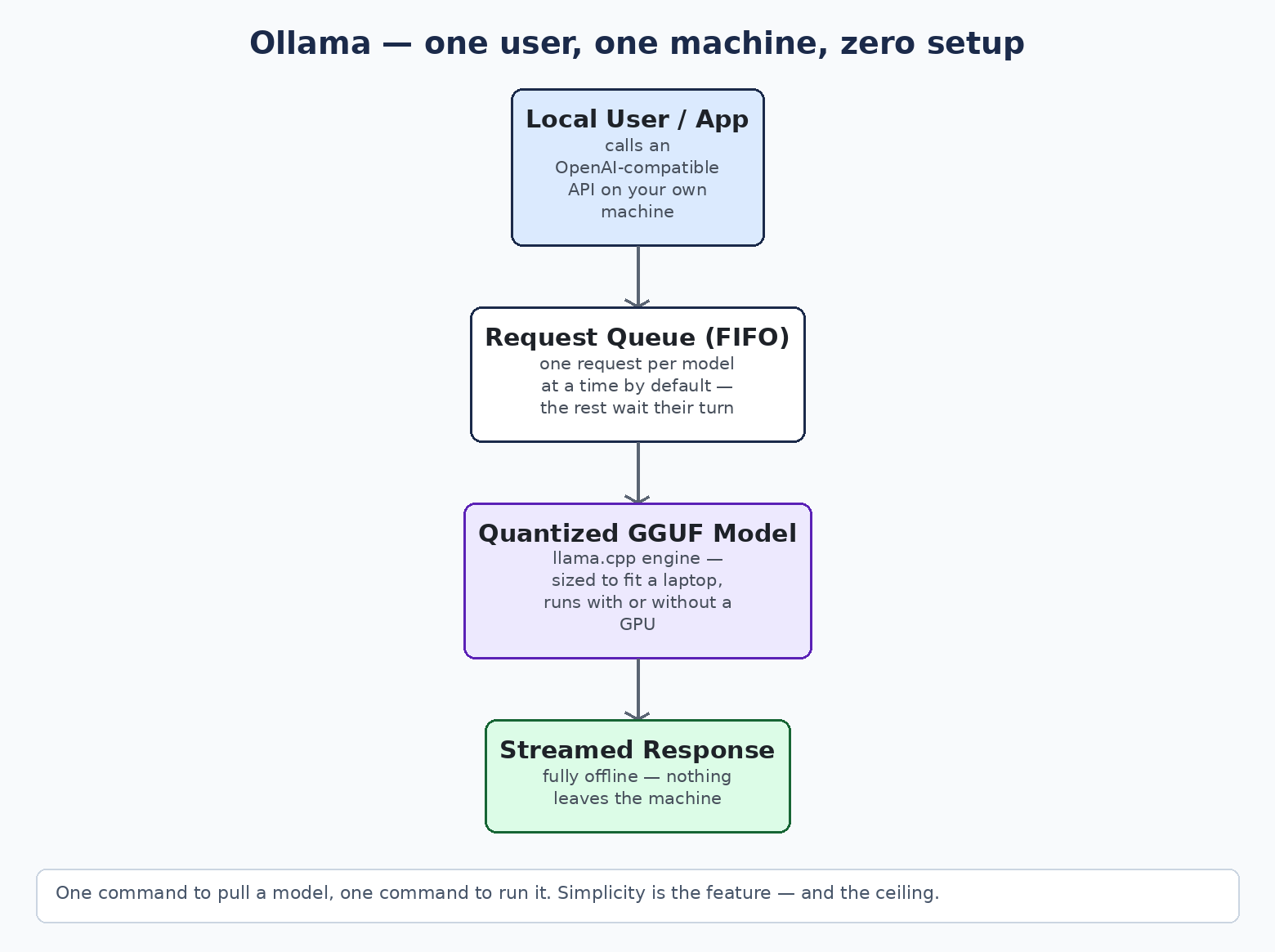
Ollama is designed around a person — one developer, one machine, minimal surface area.
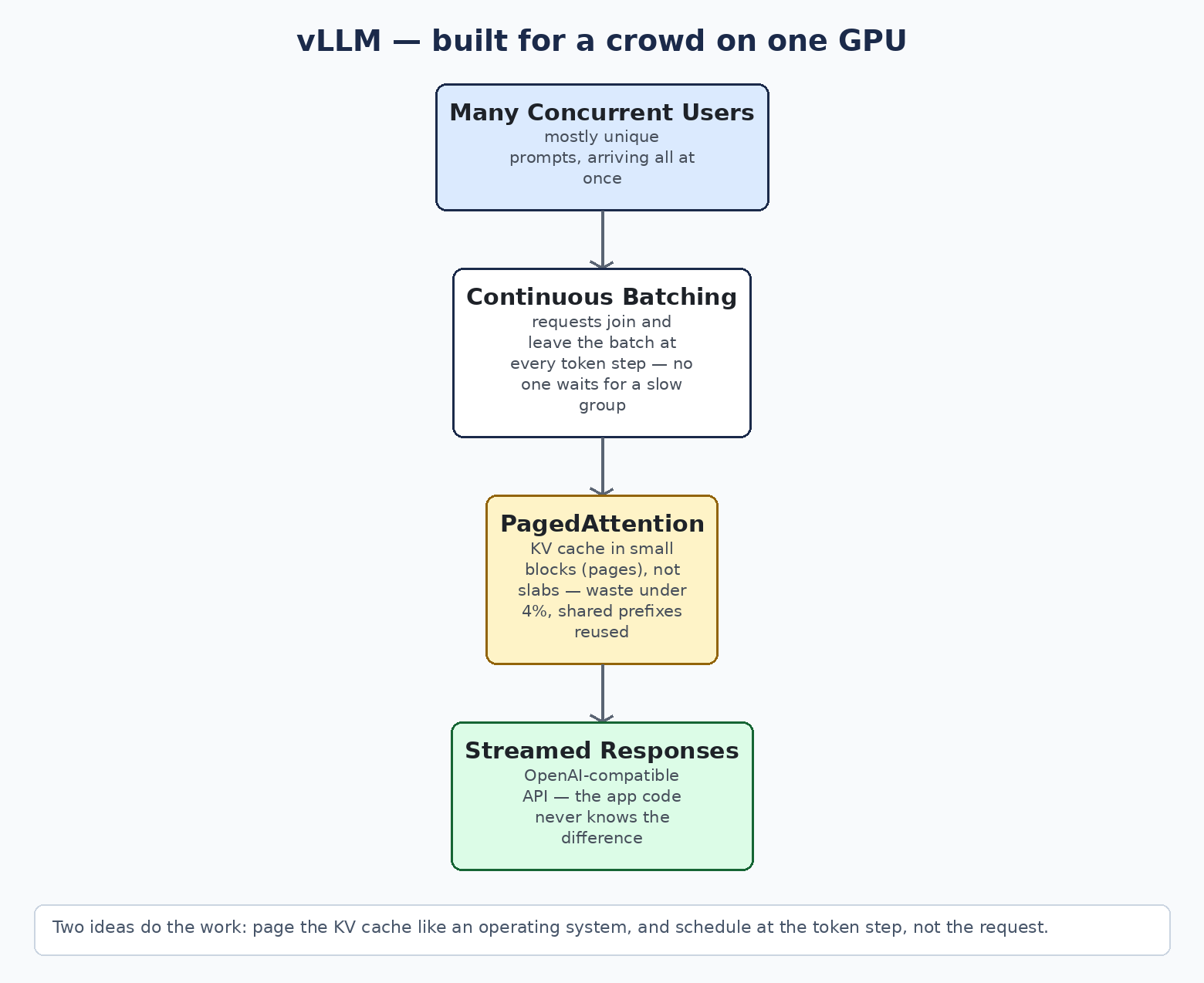
vLLM is designed around a crowd — high concurrency, mostly unique prompts, maximum throughput per GPU.
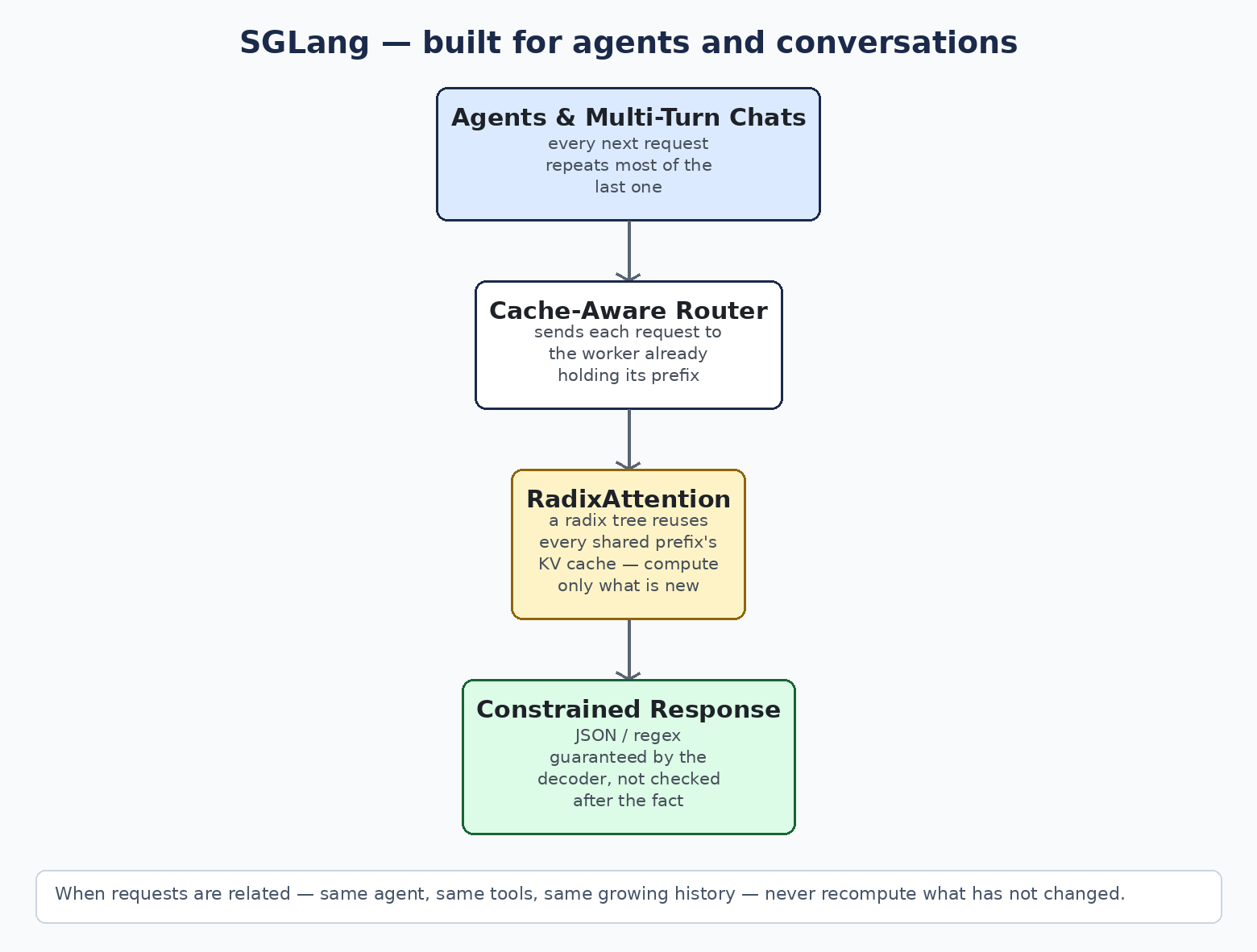
SGLang is designed around a conversation — agents and multi-turn systems whose requests share long, growing prefixes that should never be computed twice.
This deep dive works the way an architecture review should: the mechanics first, then each engine on its merits and limits, then the capacity math, the scaling patterns, the failure modes — and only then the recommendation.
The mechanics that decide everything
Serving economics are governed by a handful of mechanisms. Every claim in this article reduces to one of them.
Prefill and decode. Each request has two phases. Prefill processes the prompt — parallel, compute-heavy, done once. Decode generates the answer one token at a time, each step dependent on the last — sequential and memory-bandwidth-bound. Prefill cost scales with prompt length; decode cost scales with answer length and with how much state the engine must re-read at every step. Most serving optimization is an attack on one of these two phases.
The KV cache is the real capacity constraint. During generation, the model stores the attention keys and values for every token it has processed, so nothing is recomputed. This cache grows linearly with context length and with concurrent requests. In production, the KV cache — not the model weights — is usually what exhausts GPU memory first. How an engine allocates, shares, and evicts this cache is the single strongest predictor of how many users it can serve per GPU.
Batching, and why “continuous” changed the field. GPUs are throughput machines: processing 32 sequences together costs little more than processing one. Static batching assembles a fixed group and runs it to completion — one long generation stalls the entire group. Continuous batching (iteration-level scheduling) admits and retires requests at every token step: a finished request releases its slot instantly, a waiting one takes it. This is the mechanism behind the modern engines’ throughput advantage, and it is non-negotiable for multi-user serving.
Latency vs. throughput is a trade you make explicitly. The user-facing metrics are time-to-first-token (TTFT) and per-token latency under load; the business-facing metric is aggregate tokens per second per GPU, which is cost. Larger batches raise throughput and can raise individual latency. An architecture that does not state which side of this trade it is optimizing — interactive chat or overnight batch — is not finished.
Quantization moves the memory budget. Storing weights at 4-bit instead of 16-bit shrinks a model roughly four-fold, at a small quality cost. GGUF is the quantized format the local ecosystem standardized on. Quantization matters architecturally because every gigabyte not spent on weights is a gigabyte available for KV cache — which is to say, for users.
Prefix reuse is free throughput, if your traffic has prefixes. Requests that share a beginning — a system prompt, tool definitions, a conversation’s history — can reuse the KV cache computed for that beginning instead of recomputing it. The architectural question is never whether an engine caches prefixes; it is how granular the sharing is (whole blocks? branching trees?) and whether scheduling and routing cooperate to keep the cache warm.
Constrained decoding turns output contracts into guarantees. Forcing generation to obey a JSON schema, regex, or grammar — by masking invalid tokens during decode — converts “the model usually returns valid JSON” into “the output is valid by construction.” For agent pipelines and tool calling, this is the difference between a system and a hope.
1. Ollama — the developer-machine engine
How it works. Ollama packages the llama.cpp inference engine behind a one-command experience: pull a quantized GGUF model, run it, call it over a local API (its own REST interface, plus an OpenAI-compatible endpoint). Requests to a model are queued and processed one at a time by default (OLLAMA_NUM_PARALLEL, default 1), with up to 512 requests waiting before the server starts returning errors. Models load on demand and unload after roughly five idle minutes. Everything runs locally and offline; hosted cloud models exist as an optional extra.
Where it earns its place. Developer workstations, proofs of concept, and genuinely small internal tools. Its architectural virtue is a tiny operational surface: no cluster, no tuning, no GPU fleet — a model running in minutes on a laptop, including machines with no discrete GPU. For data-residency-sensitive experimentation, “nothing leaves this machine” is a complete architecture, and Ollama delivers it with the least ceremony in the field. A large share of enterprise AI work starts here, and low-concurrency internal tools legitimately stay here.
Where it breaks. The design center is a single user. Raise the parallel setting and each slot multiplies reserved context memory; there is no continuous batching, so under real concurrency the queue — not the GPU — becomes the bottleneck, and latency grows linearly with arrivals while the hardware idles. There is no built-in authentication (it assumes a trusted local network), no multi-GPU serving story, and no meaningful observability surface for production SLOs. None of this is a defect; it is a boundary. The failure mode is ignoring the boundary — promoting a developer tool into a serving tier because it was already installed.
The architect’s verdict. Standardize on Ollama for the inner loop: development, evaluation, demos, and isolated single-user tools. Write the exit into the design from day one — code against the OpenAI-compatible endpoint, so promoting the workload to a production engine is a deployment change, not a rewrite.
2. vLLM — the production throughput engine
How it works. vLLM, out of UC Berkeley, is built on one diagnosis: legacy serving wasted most of the KV cache. Older systems reserved each request a contiguous slab of GPU memory sized for its maximum possible generation, and the vLLM paper measured that only a small fraction of the reservation ever held live data. PagedAttention applies the operating-system answer — paging. The KV cache is divided into small fixed-size blocks, allocated wherever memory is free, with a block table mapping each request’s logical sequence to physical blocks. Waste collapses to the tail of the final block — under 4% in the paper’s measurements — and the recovered memory converts directly into larger batches. Layered on top: continuous batching at the token step, prefix caching enabled by default in the current V1 engine, tensor and pipeline parallelism for models that exceed one GPU, and the broadest model and accelerator support in the open ecosystem, behind an OpenAI-compatible API.
Where it earns its place. The default production serving tier. Public and internal API platforms with many concurrent users and mostly unique prompts; enterprise chat and RAG front doors; and batch estates — document processing, enrichment, evaluation — where overnight throughput per dollar is the governing metric. When a capacity plan says “we must carry N concurrent sessions on M GPUs,” vLLM is the engine that makes the arithmetic work, and it is the baseline against which every alternative must benchmark.
Where it breaks. It is data-center infrastructure, with a data-center footprint: it assumes real GPUs (it is not a workstation tool), and by default it claims ~90% of GPU memory, which collides with shared-card environments. The tuning surface is real — memory utilization, max concurrent sequences, block size, chunked-prefill behavior — and rewards teams that load-test over teams that guess. Its prefix caching, while solid, is block-granular and designed for breadth; workloads whose traffic is dominated by long shared prefixes are precisely the shape the next engine was designed around. Operationally, you are adopting a fast-moving platform: version discipline and upgrade testing belong in the runbook.
The architect’s verdict. Make vLLM the reference architecture for shared, multi-user LLM serving unless the workload’s shape argues otherwise. Budget the engineering honestly — load testing, tuning, GPU capacity management — because the engine’s economics only materialize when it is operated as infrastructure, not installed as a package.
3. SGLang — the engine for agent and conversation traffic
How it works. SGLang, from the LMSYS team, starts from an observation about production agent traffic: requests in these systems are not independent. An agent’s fifteenth tool call carries the same system prompt, the same tool definitions, and the same accumulated history as its fourteenth — plus one delta. RadixAttention manages the KV cache as a radix tree keyed by token prefixes: an incoming request walks the tree, reuses every matching cached prefix — including branching, multi-level sharing across sessions that diverged from a common trunk — and computes only the new suffix. Unused branches are evicted LRU-style, so the cache behaves like a cache, not a leak. The scheduler is cache-aware: it orders work so requests sharing a prefix run while their shared branch is resident, and in multi-worker deployments its router directs each request to the worker already holding that prefix. Its constrained decoding compiles the output grammar into a compressed finite-state machine, allowing the decoder to advance through forced token stretches in jumps — structured output that is both guaranteed and fast. Continuous batching and the rest of the modern toolkit are present, as they now are everywhere.
Where it earns its place. Agent platforms and tool-calling loops, where each step resends a growing context and naive serving re-bills you for your own history at every step. Multi-turn chat at scale, where a conversation’s history is literally a prefix of its next request. Few-shot and self-consistency patterns, which are prefix-sharing by construction. RAG serving with long, stable system prompts and templates. In these shapes, prefix reuse is not a micro-optimization: it compounds with concurrency (more sessions share more of the tree) and flattens the cost curve that otherwise grows with conversation length.
Where it breaks. Remove the shared prefixes and you remove the thesis: on unique, unrelated prompts, SGLang performs comparably to vLLM, and you have adopted a specialist to do a generalist’s job. Its ecosystem — documentation depth, community answers at 2 AM, day-one support for exotic new models — is smaller than vLLM’s, which is a real operational cost that belongs in the decision record. Cache-awareness also introduces a systems subtlety: routing and scheduling now have state (where prefixes live), which complicates load balancing and failover design compared to stateless round-robin over identical workers.
The architect’s verdict. Where agent and multi-turn traffic is a first-class workload — not an experiment — SGLang is the architecturally correct answer, because it is the only one of the three whose core data structure matches the traffic’s shape. Pilot it against your real prompt distribution; the prefix hit-rate in your own telemetry is the number that justifies it.
Capacity planning: the math that sizes the decision
Engine selection is inseparable from sizing. The governing equation is simple to state:
Concurrency is bought with cache. A modest model serving fifty concurrent users at long context can require more memory for KV cache than for its weights. This is why PagedAttention’s waste elimination and RadixAttention’s sharing are economic features, not academic ones — every recovered gigabyte is headroom for sessions.
Quantization is a capacity lever, not just a quality trade. Halving weight precision frees memory that converts directly into concurrent sessions or longer contexts. Evaluate quantized variants against your quality bar explicitly; for many enterprise workloads the 4-bit/8-bit quality delta is smaller than the concurrency delta is valuable.
Prefix hit-rate is a capacity input. In agent estates, a high radix-cache hit rate reduces effective prefill — often the dominant compute — by the shared fraction. Two deployments with identical GPUs can differ several-fold in carried sessions purely on how much of each prompt was already cached. Measure your prompt-overlap distribution before you size anything.
A defensible capacity plan names: target concurrent sessions, p95 context length, target TTFT and per-token latency at that concurrency, and the resulting GPU count per engine. If a vendor or a blog gives you tokens-per-second without the concurrency and context it was measured at, it has given you marketing, not engineering.
Scaling patterns
Single node → multi-GPU. When a model exceeds one GPU, tensor parallelism shards it across devices; this is a serving-tier concern (vLLM and SGLang), never a workstation one. Treat interconnect bandwidth as part of the design — tensor parallelism is chatty.
Single replica → fleet. Scale-out adds a routing tier, and here the engines diverge architecturally. Stateless round-robin is simple and works acceptably for vLLM, though per-replica prefix caches mean shared prefixes get recomputed across the fleet. For SGLang-class workloads, cache-aware routing — directing a session to the replica holding its prefix — is the difference between the design working and the design merely running. Stateful routing buys hit-rate with failover complexity; make that trade consciously.
The gateway is not optional in production. None of these engines is a complete serving platform. The reference pattern wraps the engine tier with authentication and authorization, per-consumer rate limiting and quotas, request logging for audit, and metrics that matter: TTFT and latency percentiles, queue depth, KV-cache utilization, and prefix-cache hit rate. Ollama in particular ships no authentication — anything beyond a workstation must sit behind this tier.
Failure modes worth designing for
Cache exhaustion under load spike. Long contexts × a concurrency spike exhausts KV memory; engines queue or preempt. Design the degradation: bounded context windows, admission control, and honest 429/503 behavior beat silent latency collapse.
Prefix-cache thrash. If working-set prefixes exceed cache capacity, hit rates crater and latency regresses toward the no-cache case — a cliff, not a slope. Size the cache to the working set, and alert on hit rate, not just latency.
Queue saturation on the wrong engine. Ollama’s default — one in-flight request per model, queue of 512, then refusals — is a fine workstation contract and a production outage. This failure mode is a selection error, not a product defect.
Cold starts. Multi-gigabyte model loads and engine warm-up are minutes, not milliseconds. Autoscaling policies, pre-warmed replicas, and scale-to-zero decisions must be made against that reality.
Silent quality drift via quantization mismatch. A workload validated at full precision and deployed at 4-bit (the Ollama default) is a different system than the one you tested. Pin precision in the deployment record.
The part most comparisons get wrong
Feature matrices say these engines have converged, and at the checklist level they have: continuous batching, prefix caching, structured outputs, speculative decoding, and quantization are table stakes across the serious engines. Architects should be suspicious of checklist equivalence. What differs is design center, defaults, and the data structure at the core — a FIFO queue tuned for one user, a paged cache tuned for crowd throughput, a radix tree tuned for reuse across related requests. Benchmarks alternate winners between vLLM and SGLang because benchmarks have shapes: each engine wins the workload it was designed around. The professional question is never “which engine is fastest?” It is “what does my traffic actually look like — measured, not assumed — and which design center matches it?”
The second-order point is reversibility. All three engines expose OpenAI-compatible APIs, so the application layer can be insulated from the choice. Prototype on Ollama, launch the shared tier on vLLM, carve the agent estate onto SGLang — each step is a deployment migration, not an application rewrite. An engine decision with a tested exit is a low-risk decision; insist on the exit.
The decision guide
Your situation
Pick
Why
Developer inner loop: build, evaluate, demo
Ollama
Minimal operational surface; a model running in minutes, offline, on the machine in front of you
Data-residency-bound experimentation; single user or tiny team
Ollama
Local-first by architecture; nothing leaves the machine
Shared production API: many concurrent users, mostly unique prompts
vLLM
PagedAttention + continuous batching = the most carried sessions per GPU for crowd-shaped traffic
Aggregate throughput is the governing metric; the offline batch path is built for it
Enterprise chat / RAG front door with a mixed audience
vLLM (default)
Broadest model and hardware support; prefix caching on by default in V1
Agent platforms, tool-calling loops, multi-turn systems at scale
SGLang
RadixAttention reuses the growing shared context instead of recomputing it every step
Hard structured-output contracts inside agent pipelines
SGLang
Compressed-FSM constrained decoding: guaranteed shape, without token-by-token decode penalties
Mixed estate: workstations, a shared tier, an agent platform
All three, layered
One OpenAI-compatible interface; each workload on the engine shaped for it
Record it like an architecture decision
Context. We must serve LLMs under production concurrency, latency, and cost constraints, across three distinct traffic shapes: developer experimentation, a shared multi-user tier, and agent workloads with heavy prefix overlap.
Decision. Ollama is the standard for developer workstations and single-user tools. vLLM is the reference engine for the shared production tier and batch estates. SGLang is the engine for the agent and multi-turn estate. All application code targets the OpenAI-compatible API surface; no application may depend on engine-specific behavior without an explicit exception.
Consequences. We accept operating two production engines (vLLM, SGLang) in exchange for each workload running on its matching design center. We accept cache-aware routing complexity in the agent estate as the price of prefix reuse. Engine migrations between tiers are planned deployment exercises, rehearsed against load tests built from production prompt distributions — because the only benchmark that governs this decision is our own traffic, measured.
The bottom line
Ollama, vLLM, and SGLang are not three rungs of a maturity ladder; they are three shapes of answer. One person iterating: Ollama — and keep the exit clean. A crowd to carry: vLLM — operated as infrastructure, sized by the cache math. Agents and conversations that repeat themselves: SGLang — where the radix tree turns your traffic’s sameness into your margin.
The architects who get this decision right share one habit: they measure the traffic first — its concurrency, its context lengths, its prefix overlap — and let the workload, not the benchmark blog, pick the engine.
Designing a production LLM platform, or reviewing one? The free AI Engineering Iceberg Poster and architecture toolkits cover the systems layer beneath the model — the part that decides whether the platform survives contact with real traffic.