Category: SQL Server 2008

  • How to Open Activity Monitor from SSMS tool?

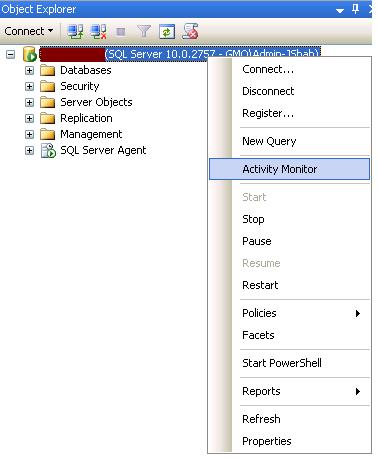
    To start Activity Monitor in SQL Server 2008 SSMS, right-click on the SQL Server name you want to monitor.

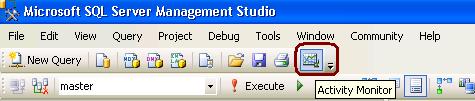
    From  SQL Server 2008 Management Studio’s toolbar, click Activity Monitor as shown in the snippet below.
  • How to check SQL Server Version Or Build No?

    Option 1
    EXEC master..sp_MSgetversion
    Output
    Character_Value
    ——————– ———– ———–
    10.0.2789.0 1 3

    Option 2
    select @@version
    Output
    Microsoft SQL Server 2008 (SP1) – 10.0.2789.0 (X64)
    Jul 12 2010 19:21:29
    Copyright (c) 1988-2008 Microsoft Corporation
    Enterprise Edition (64-bit) on Windows NT 5.2 (Build 3790: Service Pack 2)

    Option 3
    SELECT SERVERPROPERTY('productversion')
    Output Build Version
    10.0.2789.0

    Option 5
    SELECT SERVERPROPERTY ('productlevel')
    Output-Service Pack
    SP1

    Option 6
    SELECT SERVERPROPERTY ('edition')
    Output-Edition
    Enterprise Edition (64-bit)

  • Operating System Error 112

    Operating system error 112 describes the insufficient disk space on drive.

    OS Error 112 occured while Backup
    1. Delete the old backuo files on drive if not required
    2. Archieve the old files to tape
    3. Compress the old backup files to create space
    4. Take the backup on other drive

    OS Error 112 occured while Restore
    1. Shrink the data and log file using DBCC ShrinkFile to reclaim space
    2. Move un-necessary files to other drives (.Bakup or etc)

  • How to enable database mail feature in SQL Server 2005/2008?

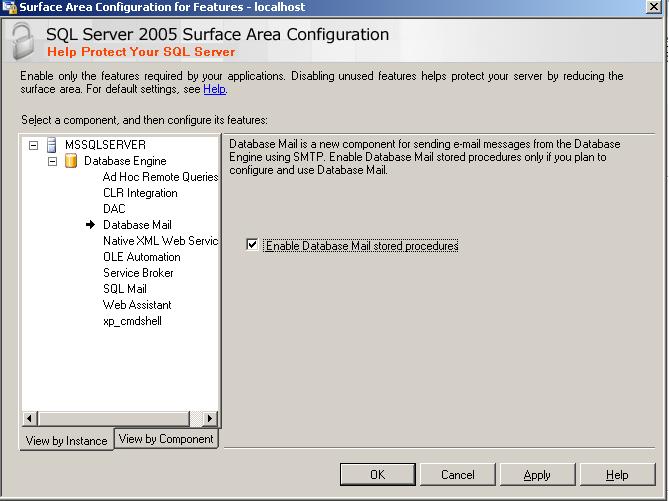
    You can enable database mail feature using Surface area configuration tool or using SP_Configure procedure.

    use master
    go
    sp_configure 'show advanced options',1
    go
    reconfigure with override
    go
    sp_configure 'Database Mail XPs',1
    --go
    --sp_configure 'SQL Mail XPs',0
    go
    reconfigure
    go

    Using Surface Area Configuration
    1. Select Surface area configuration for features

    2. Go to database page and click on check box.
  • Different types of SQL Server Database Access mode

    Different types of SQL Server Database Access mode, you can allow access to different users by setting database into below three modes.

    Syntax
    ALTER DATABASE DBNAME SET ACCESS MODE WITH ROLLBACK

    OPTIONS
    DB Access Modes
    SINGLE_USER – Single user connection to the database
    RESTRICTED_USER – Any number of users with db_owner or db creator or logins with sys admin rights can connect to the database
    MULTI_USER – Any number of users with rights to the database can connect to the database

    As you are changing the database access, you first need to take the exclusive connection database by dropping / rollback the existing connections.

    You can specify below options to rollback the existing connections.

    WITH ROLLBACK Options – Determines how the exclusive access to the database will take place
    ROLLBACK AFTER integer [SECONDS] – Rollback the SPIDs after a particular number of seconds
    ROLLBACK IMMEDIATE – Rollback the SPIDs immediately
    NO_WAIT – If all of the SPIDs do not commit or rollback immediately the request to put the database in an exclusive state will fail

    Examples

    ALTER DATABASE DBName
    SET RESTRICTED_USER WITH ROLLBACK AFTER 60 SECONDS

    ALTER DATABASE DBName
    SET RESTRICTED_USER WITH ROLLBACK IMMEDIATE

    ALTER DATABASE DBName
    SET SINGLE_USER WITH ROLLBACK IMMEDIATE

    ALTER DATABASE DBName SET MULTI_USER