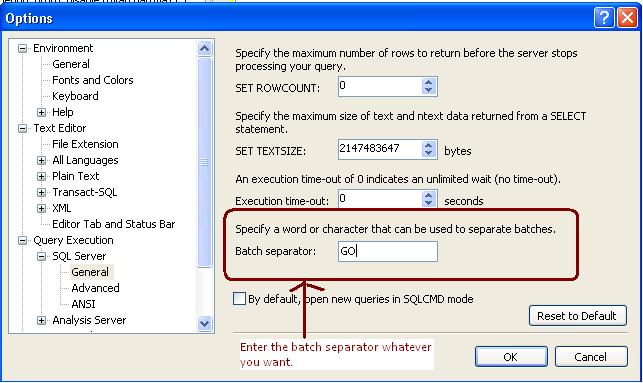
It is often asked by the people can we change the batch separator T-SQL. Answer is yes we can change the batch separator.
We can do it by Tools->Options->Query Execution->SQL Server->General->Batch separator
It is often asked by the people can we change the batch separator T-SQL. Answer is yes we can change the batch separator.
We can do it by Tools->Options->Query Execution->SQL Server->General->Batch separator
As best practice it is recommended that you have to backup date time with the backup file name so anyone can get the idea of Backup creation.
Sometimes due some issue we took backup without specifying the datetime with the backup file name so during restore we are unsure that how much data backed up in the backup file, type of backup, Is it Copy only and more.
SQL Server stores the Backup Metadata into backup header. You can restore header only command to get the required information.
RESTORE headeronly FROM disk = ‘c:\jshah.bak’
| Column Name | Values | Description |
| BackupName | NULL | |
| BackupDescription | NULL | |
| BackupType | 1 | Backup type: 1 = Database 2 = Transaction log 4 = File 5 = Differential database 6 = Differential file 7 = Partial 8 = Differential partial |
| ExpirationDate | NULL | |
| Compressed | 0 | 0 = Un-Compressed Backup 1 = Compressed Backup |
| Position | 1 | |
| DeviceType | 2 | |
| UserName | JShah | |
| ServerName | SQLDBPool | |
| DatabaseName | jshah | |
| DatabaseVersion | 655 | |
| DatabaseCreationDate | 12/31/10 9:55 AM | |
| BackupSize | 1453056 | |
| FirstLSN | 28000000006000100 | |
| LastLSN | 28000000013000000 | |
| CheckpointLSN | 28000000006000100 | |
| DatabaseBackupLSN | 0 | |
| BackupStartDate | 12/31/10 10:06 AM | |
| BackupFinishDate | 12/31/10 10:06 AM | |
| SortOrder | 52 | |
| CodePage | 0 | |
| UnicodeLocaleId | 1033 | |
| UnicodeComparisonStyle | 196609 | |
| CompatibilityLevel | 100 | |
| SoftwareVendorId | 4608 | |
| SoftwareVersionMajor | 10 | |
| SoftwareVersionMinor | 0 | |
| SoftwareVersionBuild | 2757 | |
| MachineName | SQLDBPool | |
| Flags | 512 | 1 = Log backup contains bulk-logged operations. 2 = Snapshot backup. 4 = Database was read-only when backed up. 8 = Database was in single-user mode when backed up. 16 = Backup contains backup checksums. 32 = Database was damaged when backed up, but the backup operation was requested to continue despite errors. 64 = Tail log backup. 128 = Tail log backup with incomplete metadata. 256 = Tail log backup with NORECOVERY. |
| BindingID | 85A5505D-ADB1-4B33-A181-549DC520A0F8 | |
| RecoveryForkID | 03DE5437-1E27-4885-9011-91CFED12338A | |
| Collation | SQL_Latin1_General_CP1_CI_AS | |
| FamilyGUID | 03DE5437-1E27-4885-9011-91CFED12338A | |
| HasBulkLoggedData | 0 | 1 = Yes 0 = No |
| IsSnapshot | 0 | 1 = Yes 0 = No |
| IsReadOnly | 0 | 1 = Yes 0 = No |
| IsSingleUser | 0 | 1 = Yes 0 = No |
| HasBackupChecksums | 0 | 1 = Yes 0 = No |
| IsDamaged | 0 | 1 = Yes 0 = No |
| BeginsLogChain | 0 | 1 = Yes 0 = No |
| HasIncompleteMetaData | 0 | 1 = Yes 0 = No |
| IsForceOffline | 0 | 1 = Yes 0 = No |
| IsCopyOnly | 0 | 1 = Yes 0 = No |
| FirstRecoveryForkID | 03DE5437-1E27-4885-9011-91CFED12338A | |
| ForkPointLSN | NULL | |
| RecoveryModel | FULL | |
| DifferentialBaseLSN | NULL | |
| DifferentialBaseGUID | NULL | |
| BackupTypeDescription | Database | |
| BackupSetGUID | 62EB4399-C119-42C2-91F1-BF0FF19CB896 | |
| CompressedBackupSize | 1453056 |
Problem
Today I got an email from one of my blog reader; they have an application developed with VB6.0 and SQL Server 2000. Application was developed long back and now their database size is increased as well. Due un-efficient coding they are getting blocking issue and stuck all their application transactions. He asked for writing a query which will execute by SQL Server Agent at every 1 minute and will KILL the culprit SPID. He also wants me to store the KILL transaction history as well.
As a solution I have written below query for him and which working fine now.
-- Create below table in master database
 create table blkHistory
(
	SPID int,
	blocked int,
	killedSPID int,
	date datetime default getdate(),
	querytext varchar(8000)
)


-- add below code in to job command text box
declare @SPID as int,
        @blocked as int,
        @KilledSPID as int

declare @querytext as varchar(8000), @sql nvarchar(400)

select @SPID = spid,@blocked = blocked from sysprocesses where blocked <> 0

--select spid,blocked from sysprocesses where blocked <> 0

select @sql = 'KILL ' + cast (@blocked as nvarchar(100))

DECLARE @Handle binary(20)
SELECT @Handle = sql_handle FROM sysprocesses WHERE spid = @blocked

SELECT @querytext = text FROM ::fn_get_sql(@Handle)

EXECUTE sp_executesql @SQL

If @SPID > 0
begin
insert into blkHistory(SPID,blocked,KilledSPID,querytext)
values (@SPID,@blocked,@blocked,@querytext)
end

--you can use below query to retrieve datafrom blocking history
select * from master..blkHistory
|
You can follow the below steps to enter error log records into temporary table and query it.
-- Command will create the temporary table in tempdb CREATE TABLE [dbo].[#TmpErrorLog] ([LogDate] DATETIME NULL, [ProcessInfo] VARCHAR(20) NULL, [Text] VARCHAR(MAX) NULL ) ; -- Command will insert the errorlog data into temporary table INSERT INTO #TmpErrorLog ([LogDate], [ProcessInfo], [Text]) EXEC [master].[dbo].[xp_readerrorlog] 0 ; -- retrieves the data from temporary table SELECT * FROM #TmpErrorLog |
Whenever backup peformed on SQL Server, it records the backup entry in the SQL Server. Because of that error log file grows and sometimes we are missing important information from there.
For example,
use master backup database jshah to disk = 'c:\jshah.bak' |
Above command will log the below message in the SQL Server error log.
Backup Message:
Database backed up. Database: jshah, creation date(time): 2010/12/31(09:55:22), pages dumped: 178, first LSN: 28:60:170, last LSN: 28:130:1, number of dump devices: 1, device information: (FILE=1, TYPE=DISK: {‘c:\jshah.bak’}). This is an informational message only. No user action is required.
Solution
As a solution we can turn on the trace flag 3226 to stop loging of sucessfull backup message.
You can turn it on either using SQL Server Service Starup Parameter (-T 3226) or using DBCC TRACEON command.
-- To turn on the trace flag at global level DBCC TRACEON (3226,-1) -- To turn off the trace flag at global level DBCC TRACEOFF (3226,-1) |
 aiDeeva.com